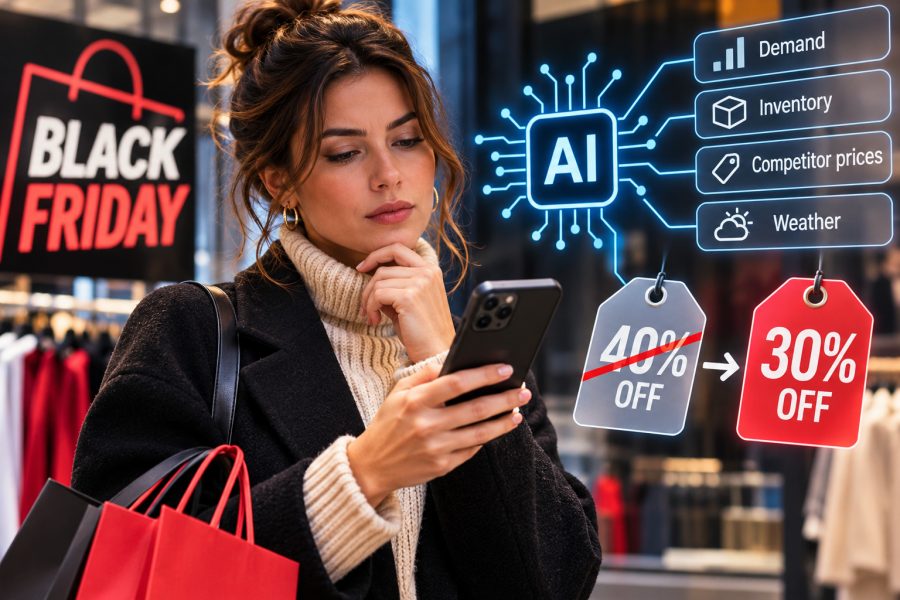
Black Friday shoppers could face less generous discounts this year as retailers increasingly use artificial intelligence (AI) to predict demand and decide how much to reduce prices to attract customers. Consumer brands are turning to AI-powered tools to manage inventory, recommend retail prices and determine when promotional offers are needed. The technology analyses sales history, stock levels, competitors' prices, weather conditions and economic data to estimate how demand might change at different price points.
For retailers, the objective is to protect profit margins without losing customers. However, the growing use of these systems could mean smaller savings for shoppers during one of the year's biggest shopping events.
How AI Is Changing Black Friday Discounts
Retailers are using AI to make more informed decisions about pricing and promotions, with some systems recommending fewer discounts or smaller reductions. AI pricing firm Kapnova advised an unnamed billion-dollar beauty company to reduce its planned Black Friday discount on a skincare product from 40 per cent to 30 per cent. Chief executive James Sun said the technology indicated that the smaller reduction could be sufficient. The company was not identified, and it remains unclear whether the recommendation was adopted.
Another pricing technology company, First Insight, suggested that an unnamed brand reduce a buy-one-get-one promotion from 50 per cent to 40 per cent, according to founder Greg Petro. Both examples show how predictive tools can help retailers assess whether deeper discounts are needed to drive sales.
Impact Analytics, which counts Gap among its clients, also provides software for markdown decisions. Chief executive Prashant Agrawal said its technology generally indicates that retailers need fewer promotions, run them for shorter periods, and cover fewer products. Gap has confirmed that it uses the software to make markdown decisions based on demand and inventory signals.


Fashion and Luxury Brands Are Also Using AI Pricing Tools
The technology is not limited to high-street retailers or beauty businesses. Fashion and luxury companies are also using software to inform pricing and inventory decisions. Under Armour and Family Dollar use First Insight to assess product prices and estimate how changes could affect sales. Anaplan, a planning software company, has also said that Tiffany & Co., Dolce & Gabbana and Yves Saint Laurent use its platform for pricing.
The adoption of these systems reflects retailers' growing interest in responding more precisely to changes in consumer demand. A 2025 Global Pricing Study by consultancy Simon-Kucher, which surveyed more than 2,200 business leaders across 28 countries and 39 industries, found that 33 per cent of respondents used AI for demand forecasting, while 28 per cent used it for real-time price optimisation.
Could Shoppers Be Getting Smaller Discounts?
Figures compiled by Centric Market Intelligence showed that a greater share of sportswear products were discounted over the previous year, while average reductions fell. An on-sale sports bra, for example, carried an average discount of 32 per cent, compared with 36 per cent the year before.
Although the figures suggest that discounts are becoming more widespread but less generous, they do not establish that AI pricing systems caused the reductions. Shoppers may therefore see more promotions with smaller savings, although this does not mean every retailer uses AI to reduce discounts.
AI Pricing Is Not the Same as Personalised Pricing
Predictive pricing systems do not necessarily set different prices for individual shoppers. Many assess demand across products or categories to recommend general markdowns. Dynamic pricing allows businesses to adjust prices in response to demand, inventory and other market conditions without necessarily considering personal customer information. Personalised pricing, by contrast, uses customer-specific information to determine an individual's price or offer.
Former McKinsey consultant and e-commerce executive Sofia Serra described dynamic pricing as one step removed from personalised pricing, raising legal and ethical questions as the technology develops.
What Black Friday Shoppers Should Watch For
The US National Retail Federation forecasts that retail sales during November and December 2026 will reach $1 trillion (£775 billion), a 4.2 per cent increase on 2025. As retailers seek to protect profits, AI could influence how promotional offers are structured.
Shoppers can protect their budgets by checking prices before sales begin, comparing offers across retailers and reviewing previous prices to establish whether advertised reductions represent genuine savings. As AI becomes more involved in retail pricing, the biggest Black Friday discount may not always be the one advertised most prominently.