Alexander McQueen has returned to London Fashion Week, but not without controversy. While Sean McGirr's Spring/Summer 2027 collection channelled London's underground energy through smoky romanticism, sharp tailoring and flashes of neon, some viewers were left asking a more uncomfortable question: does it actually feel like McQueen? For a house synonymous with subversion, theatricality and an uncompromising creative vision, the response has been decidedly mixed.
Few designers changed the language of fashion as dramatically as Lee Alexander McQueen. The London-born designer challenged conventions not only through his clothes, but through the very idea of what a fashion show — and a fashion designer — could be. His work fused technical precision with provocation, romance with brutality, and beauty with a distinctly British darkness.
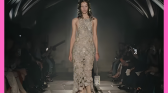
Twenty-five years after Alexander McQueen moved its main runway shows from London to Paris, the house has returned to the official London Fashion Week schedule under creative director Seán McGirr. For Spring/Summer 2027, McGirr looked to the city itself, drawing on its street-level counterculture, historical contrasts and restless nightlife.
The result was a collection built around opposing forces: ethereal craftsmanship against rigid urban silhouettes, delicate fabrics against hard-edged leather, and romanticism disrupted by flashes of something more abrasive.
Backstage at the McQueen Spring Summer 2027 show.
— McQueen (@McQueen) September 21, 2026
Video: Reya Race
Music: A. G. Cook pic.twitter.com/Rj0qdt0l3A
An Ode to London's Counterculture
The show took place at the Undercroft at Lincoln's Inn Chapel, where front-row guests including Salma Hayek, Emilia Clarke, Lila Moss and Alexa Chung gathered beneath the venue's imposing architecture. The atmosphere was deliberately theatrical, with the chapel transformed into a dark, smoky setting as a live choir sang between its pillars.
That sense of drama carried into the clothes.
Smoked tulle was juxtaposed with acid floral motifs, while lacquered, high-gloss satin appeared alongside structured leather harnesses. The colour palette moved between muted shades reminiscent of religious paintings and washed-out neon hues drawn from London's underground rave culture.
On paper, it was unmistakably McQueen territory: darkness, tension, sexuality and rebellion, all filtered through the visual language of London.
But translating the mythology of McQueen into a new era is a considerably harder task than referencing it.
The Reaction: Is It McQueen Enough?
The collection quickly divided opinion online, with some viewers applauding its strongest looks while others felt that the house's references to its past had not translated into a convincing new creative direction.
One Reddit commenter dismissed the collection as 'tired and underwhelming', arguing that it bore little resemblance to Lee McQueen's work.
Another commenter praised 'some nice looks' and flashes of McQueen's heritage but said the collection lacked Lee McQueen's 'DNA'.
A Reddit user's opinion offered a more measured assessment: 'It's not all a home run, but there are some really strong looks in there.'
And perhaps that is where the collection's most interesting tension lies. McGirr does not appear to be ignoring the house's history; if anything, the collection is steeped in the visual codes that made McQueen such a powerful name in fashion. The question is whether those codes can be reinterpreted without simply becoming echoes of the past.


The Problem With a Legend
For any creative director taking over a fashion house founded by one of the industry's most influential designers, the challenge is enormous. There is an expectation to preserve the DNA of the brand while simultaneously giving it a reason to exist in the present.
McQueen presents an especially difficult case. The founder's work was so closely tied to his personality, perspective and technical mastery that separating the house from the man has never been straightforward.
That leaves subsequent designers with a delicate balancing act. Lean too heavily on the archive and the collection risks feeling derivative. Move too far away from it and the brand risks losing the identity that made its name significant in the first place.
McGirr's London return sits directly within that tension. There are clear references to the house's rebellious heritage, from the dramatic setting and sharply constructed silhouettes to the collision of romance and aggression. Yet for some viewers, those ingredients did not add up to the singular vision they associate with Lee McQueen.
Whether that response changes as McGirr's tenure develops remains to be seen. For now, McQueen's return to London has succeeded in provoking precisely the kind of conversation that surrounded the house in its most disruptive years—only this time, the question is not what McQueen will do next, but what McQueen can become without McQueen himself.
Check back for more coverage of the major shows from this year's London Fashion Week.