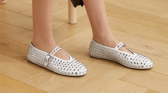

There's always a pair of shoes you end up relying on more than anything else.
Not the ones you bought for a specific occasion, or the ones you were convinced would change your wardrobe—but the pair you reach for without thinking. The ones by the door. Slightly worn, easy to slip on, somehow working with everything, even when the rest of your outfit doesn't quite come together.
For a lot of women, that pair is a white trainer.
And yet, finding the right one can feel oddly difficult. You buy a pair that looks perfect online, only to realise it rubs slightly at the heel. Or feels too flat after a long day. Or just doesn't sit right with the way you actually dress.
It's rarely about trends. It's about finding something that fits into your life properly.
Why white trainers never really leave your wardrobe
Something is reassuring about white trainers.
They don't demand much. They don't date quickly. And they have a way of softening an outfit without making it feel too casual. You can wear them with jeans, tailoring, dresses — even things you weren't entirely sure would work — and they tend to pull everything together quietly.
Part of it is practical. Life doesn't always allow for delicate shoes or uncomfortable ones. You need something you can walk in, stand in, live in.
But there's also something slightly personal about them.
A bright, box-fresh pair says one thing. A well-worn pair, creased in the right places, says something else entirely. They become part of how you move through your day—commuting, running errands, meeting friends, getting caught in unexpected rain.
They're less of a statement, more of a constant.
The difference between a good pair and one you regret buying
Most people have bought at least one pair of white trainers that didn't quite work. They looked right. Maybe even felt fine at first. But after a few wears, something was off.
Usually, it comes down to small details.
A sole that's just a bit too flat. Leather that feels stiff rather than supportive. A shape that looks great with one outfit, but slightly awkward with everything else. Or the simple fact that they're too much effort to keep clean, so you stop reaching for them altogether.
Comfort matters more than people expect. Not in an obvious, cushioned, 'gym trainer' way—but in the sense that you don't notice them while you're wearing them.
The best pairs are the ones you forget about entirely once they're on.
A Quiet Shift: From 'trendy' to 'wearable'
White trainers have gone through phases — chunky, minimal, retro, exaggerated — but what's settled over time is something more wearable.
You still see variation, of course. Some people lean towards a cleaner, more pared-back look. Others prefer something with a bit more shape or presence.
But overall, there's been a move away from anything that feels too forced.
What people seem to want now is balance. Something that works with real outfits, not just styled ones. Something that can handle a full day out without needing to be swapped halfway through.
It's less about making a statement, more about fitting in naturally.

What you notice after wearing them for a full day
This is usually where the difference becomes clear.
A good pair will carry you through a long day without much thought—walking between places, standing longer than expected, adjusting to whatever the day turns into.
A less practical pair starts to make itself known. You shift your weight more. You notice pressure points. You think about taking them off the moment you get home.
It's subtle, but it adds up.
That's why trying to judge trainers based purely on how they look rarely works. You only really understand them once they've been part of your routine for a while.
Materials, shape, and the little things that matter
There are a few things people tend to learn the hard way.
Leather, for example, tends to hold up better over time. It's easier to wipe clean, and it softens with wear rather than falling apart. Canvas can feel lighter, but it often shows wear more quickly.
Shape matters more than expected, too. A slightly slimmer trainer can work well with tailored pieces or dresses, while a bit more structure can balance looser, more relaxed outfits.
And then there's practicality—the kind you don't think about until it matters. Can you clean them quickly before heading out? Do they still look decent after a few wears? Do they hold their shape, or do they start to look tired too soon?
These are the things that turn a good purchase into a reliable one.
Where British brands tend to get it right
There's something quite specific about buying trainers that work for everyday life here.
They need to handle a bit of unpredictability—the weather, the pavements, the general pace of things.
Brands like Stepney Workers Club have built a following for exactly that reason. Their trainers feel considered but not overly polished. You can wear them regularly without worrying too much about keeping them pristine.
Russell & Bromley leans slightly smarter, which works well if you want something that sits comfortably between casual and put-together.
Even Marks & Spencer, often overlooked in this space, tends to offer surprisingly solid options—the kind you can wear often without overthinking the cost.
You're usually looking at anywhere between £35 and £200 ($45–$250) depending on what you go for. And in most cases, it's less about the price and more about how often you'll realistically wear them.
Styling them without overthinking it
White trainers work best when they're not the centre of attention. They're there to support the outfit, not define it.
That's why the simplest combinations tend to feel the most natural—straight-leg jeans, relaxed trousers, a dress that needs grounding slightly. Even tailoring feels less rigid when paired with something understated on the foot.
It's not about getting it 'right'. It's about letting them fit into what you already wear. Once you stop thinking of them as a styling decision and more as a default, they become much easier to wear.

Keeping them clean (within reason)
There's always a moment when white trainers stop being perfectly white. And that's usually fine. In fact, a slightly worn pair often looks better—more lived-in, less precious.
That said, a bit of upkeep helps. A quick wipe here and there, avoiding the worst of the weather when possible, not letting marks build up too much.
It doesn't need to be a whole routine. The goal isn't perfection. It's just keeping them in a state where you still want to wear them.
Are they worth spending more on?
It depends on how you use them.
If they're something you wear occasionally, there's no real need to spend much. But if they're part of your daily routine — something you rely on constantly — it can make sense to invest a bit more.
Better materials tend to last longer. Better construction tends to feel more comfortable over time. But equally, a reasonably priced pair that you wear every day is often a better value than an expensive one that sits untouched. It comes down to wear, not just price.
A final thought
The best white trainers aren't the ones that look perfect in photos or feel like a trend you need to keep up with.
They're the pair that quietly become part of your life.
The ones you don't think twice about putting on. The ones that work with how you actually dress, move, and go about your day.
And once you find that pair, you tend to stick with them—not because they're exciting, but because they make everything else feel that bit easier.