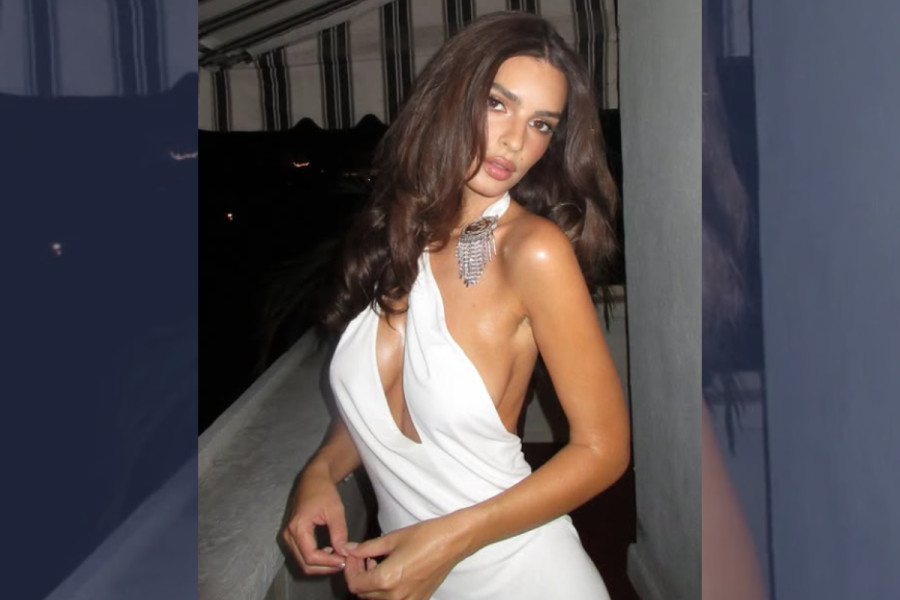
Emily Ratajkowski agreed to appear topless in Robin Thicke's 2013 music video for 'Blurred Lines'. However, what she says she did not agree to was the singer grabbing her breasts during filming. More than a decade later, the circumstances surrounding one of the most commercially successful music videos of her career are once again being put under the microscope.
On Thursday, 26 November, an X post revisiting Emily Ratajkowski's allegations and her experiences with the commercialisation of her image garnered 1.5 million views, triggering renewed discussions about consent, exploitation, and the power dynamics women navigate in the entertainment industry.
The accompanying footage comes from a November 2021 interview in which the model discussed her book, My Body, a collection of personal essays examining her relationship with beauty, sexuality, money, and power. Among the experiences she revisited was the music video that helped turn her into a household name at 21.
When the Power Dynamics on Set Became Clear
Speaking to CBS Mornings on 8 November 2021, Ratajkowski recalled how comfortable she initially felt filming 'Blurred Lines'. With women occupying prominent positions behind the camera, including the director and cinematographer, the young model found herself enjoying the experience.
That sense of security, she alleged, was disrupted when Thicke touched her breasts without her consent. Despite the predominantly female crew, Ratajkowski felt that challenging the singer could have jeopardised her position.
Emily Ratajkowski was 21 and topless in the "Blurred Lines" video. She says Robin Thicke grabbed her bare breasts on set. Then a photographer published a whole book of her nude Polaroids without asking, and an artist sold a picture of her own Instagram photo for $80,000. She had… pic.twitter.com/NmGAu0opIG
— Quantex (@Quantex0x) November 25, 2026
'If we had stopped the set, there's another prettier girl who would be happy to be in my place,' she explained.
Music video director Diane Martel corroborated Ratajkowski's account, recalling that she confronted Thicke over his behaviour and that the singer apologised.
The song itself was no stranger to controversy. In addition to criticism of its lyrics and accompanying visuals, 'Blurred Lines' became the subject of a copyright dispute involving Marvin Gaye's 1977 song 'Got to Give It Up'. A $5.3 million judgment against Thicke and Pharrell Williams was upheld on appeal in 2018.
The Price of Owning Her Own Image
The 'Blurred Lines' experience was not the only occasion on which Ratajkowski questioned how much control she had over her body and image.
In 2020, the model accused photographer Jonathan Leder of sexually assaulting her following a photoshoot in 2012. She also alleged that he published intimate photographs from the shoot without her authorisation. Leder reportedly denied the assault allegation and disputed her claims regarding the publication of the photographs.
Meanwhile, American artist Richard Prince incorporated an image from Ratajkowski's Instagram account into his series of artworks based on social media posts.
After discovering that the original piece, priced at $80,000, had already been sold, Ratajkowski and her then-boyfriend jointly purchased another Prince artwork featuring her image for $81,000.

The photograph used in the latter artwork originated from a 2014 Sports Illustrated photoshoot for which Ratajkowski had received $150.
The massive discrepancy between those figures illustrates a separate question facing models whose images become commercially valuable: how much control do they retain over the use of their likeness once the camera stops clicking?
Exploitation or Empowerment? X Users Weigh In
The resurfaced interview prompted several X users to express sympathy for Ratajkowski, particularly regarding her comments about feeling professionally replaceable.
'Exploited. The line about another prettier girl waiting to take her place says it all. Nobody feels free to say no when that's the deal,' one user wrote.
'Every version of this story ends with someone else cashing the check on her image,' another remarked.
Others interpreted Ratajkowski's sentiments primarily as a financial dispute rather than an issue of autonomy.
'Let's be real, the issue here is money, not nudes,' one commenter argued.
Another insisted that the model must have signed releases permitting the publication of her photographs, although the commenter provided no evidence of the terms of any such agreement.
Ratajkowski has acknowledged that capitalising on her sexuality brought her professional opportunities. Nevertheless, her decision to revisit those experiences was intended to present a more complete account of the industry in which she built her career.
Enjoying a photoshoot, benefiting financially from modelling, and choosing to appear nude are not inherently a green light for exploitation. Consent to appear in front of a camera does not grant everyone behind it unrestricted access to the person being photographed. A woman can bare it all without anyone blurring the lines on her right to say no.