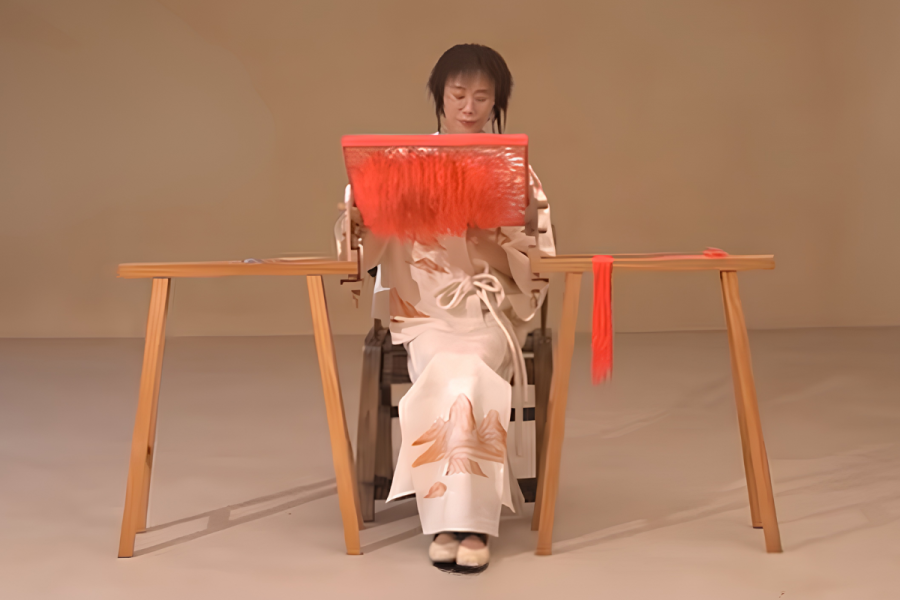
A striking textile artwork showing a school of orange koi has caught attention online, with the piece credited to Chinese embroidery artist Lin Xia. The work uses Taizhou embroidery, a craft from Zhejiang province known for its openwork and detailed thread work.
The image shows Lin Xia holding the sheer textile, allowing viewers to see dozens of fish stitched across the fabric. While the online post describes the work as a koi fish piece, the exact title and date of the artwork could not be independently confirmed from a primary source, so those details are not being added as fact.
A School of Fish Made from Thread
At first glance, the artwork looks almost like a light orange fish pattern floating across a sheet of lace. A closer look shows rows of fish made with thread, giving the flat fabric a lively and detailed look.
A textile art piece featuring a school of koi fish crafted by master embroidery artist Lin Xia using traditional Taizhou embroidery techniques. pic.twitter.com/HVbFvaIBEf
— PmAmTraveller (@pmamtraveller) October 4, 2026
The fish are placed across an open, net-like background, which allows light and space to become part of the design. This use of open areas fits the wider style of Taizhou embroidery, which is known for techniques that cut, pull and shape parts of the fabric.
The result is very different from a normal embroidered picture. Instead of covering the whole fabric with stitches, the design leaves large areas open, helping the fish stand out.
Lin Xia's Taizhou Embroidery
Lin Xia is a third-generation inheritor of Taizhou embroidery and has spent more than 40 years working with the craft. She is also recognised as a master of Chinese arts and crafts and has helped bring traditional Taizhou embroidery into modern art and fashion.
Her connection to the craft started when she was young, when she learned to work with needle and thread around her grandmother. At 16, she passed an exam to become a designer at a major embroidery garment factory in Taizhou.
Over the years, Lin has worked to move Taizhou embroidery beyond older patterns and uses. Her work has mixed traditional stitching with new shapes and ideas, helping the craft reach modern art, clothing and other creative products.


What Makes Taizhou Embroidery Different?
Taizhou embroidery, also called Taixiu, developed in Taizhou in Zhejiang province. Western embroidery methods such as cutwork and drawnwork reached the area in the early 20th century and later mixed with local Chinese embroidery skills.
One of its most striking features is the way fabric can be cut or pulled away as part of the design. This creates open spaces that can make an embroidered piece look more like lace while still keeping the work's handmade detail.
Lin has pushed this idea even further through her own approach to embroidery. Her work uses methods including pulling, cutting and carving the fabric to create pieces with more depth and texture than a simple flat embroidered image.
From Traditional Craft to Modern Art
The koi artwork shows why Taizhou embroidery can feel fresh even though the craft has deep roots. The bright orange fish appear to move across the sheer fabric, while the open background gives the piece a light and airy look.
Fish have also appeared in Lin's wider body of work. An official Taizhou source says her 'Yu' or fish series takes inspiration from the yellow croaker of Dachen Island and uses traditional hand-embroidery methods to give the designs a more three-dimensional look.
When traditional embroidery meets contemporary art.
— DiscoverZhejiang (@discoverzj) October 2, 2026
Artist Lin Xia reimagines Taizhou embroidery through modern design and innovative techniques, bringing centuries-old craftsmanship into a new artistic expression.
Taizhou, Zhejiang pic.twitter.com/HHWUlMyPRQ
That mix of old skills and new ideas is central to Lin's work. Her approach has helped show that traditional embroidery does not have to stay on old-style clothing or decorations, but can also become a form of modern textile art.
The viral image may have introduced many viewers to Lin Xia's work through a simple school of stitched fish. But behind the eye-catching design is a much bigger story about how Taizhou embroidery is being kept alive while finding a place in modern art and fashion.