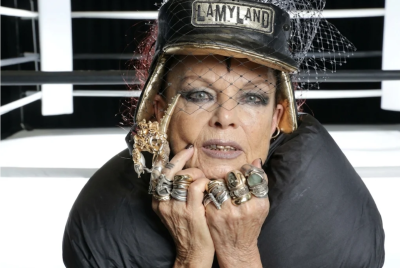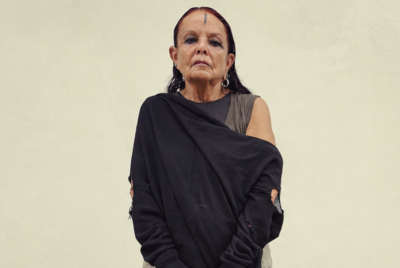
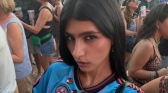
Mugler has chosen Vivian Jenna Wilson to front its Fall/Winter 2026–27 campaign, The Commander, a provocative fashion story exploring power, desire and the shifting relationship between authority and control. Through a series of cinematic images, Wilson moves between commanding, observing, obeying and refusing, challenging conventional ideas about what it means to hold power.
Unveiled on 11 September 2026, the campaign accompanies the second runway collection in Mugler creative director Miguel Castro Freitas' A Trilogy of Glorified Clichés. The wider project explores archetypes associated with the fashion house, with this instalment focusing on power dressing as both armour and performance. The collection itself was presented in Paris on 6 March 2026, several months before the campaign's release.
Rather than treating authority as a fixed position, The Commander examines how it can be claimed, performed and exchanged. Wilson's changing roles provide a visual language for exploring vulnerability, freedom and the appeal of traditional symbols of power.
Vivian Jenna Wilson Stars In Mugler's The Commander
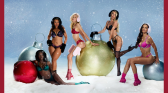
Wilson takes centre stage in the campaign's cinematic tableaux, which place her in situations where control and submission are not presented as permanent opposites. The imagery moves through different expressions of authority, challenging familiar expectations about who commands and who follows.
The theatrical presentation combines glamour with an underlying sense of danger, drawing on the tension between obedience and refusal. Wilson's shifting roles give the campaign its central narrative, presenting power as something that can be negotiated rather than permanently assigned.


Miguel Castro Freitas Reimagines Mugler's Power Dressing
For Castro Freitas, the campaign builds on one of Mugler's defining fashion codes: power dressing. However, his interpretation moves beyond the conventional association between sharp tailoring and authority, examining why these visual symbols remain appealing and what happens when women reclaim them. 'Power dressing has always been part of Mugler's language, but I wanted to look beyond the obvious idea of authority,' Castro Freitas said. 'What interests me is the seduction of power – why we are attracted to these symbols, and what happens when we decide to take them back for ourselves.'
The collection forms part of the designer's wider exploration of the archetypes that have shaped Mugler's identity. Through The Commander, structured clothing becomes a form of protection and performance, while the campaign questions expectations attached to traditional ideas of femininity and authority. Beneath the polished presentation, Castro Freitas introduces a more instinctive tension between etiquette and desire. The imagery embraces theatrical excess, allowing beauty, eroticism and absurdity to exist within the same visual world.
The Commander Explores Freedom Through Fashion
The campaign's central idea is that freedom does not necessarily mean the absence of power. Instead, Mugler presents it as the ability to decide how power is used, whether through accepting a role, rejecting it or changing the rules altogether. That interpretation gives The Commander a broader meaning beyond its clothes. The campaign uses fashion to question familiar hierarchies and explore how authority can be performed, challenged and reclaimed.
With Wilson at its centre, Mugler's Fall/Winter 2026–27 campaign turns power dressing into a cinematic examination of control and self-determination. Rather than offering a single definition of authority, The Commander leaves the question open: who commands, who obeys and who gets to decide?