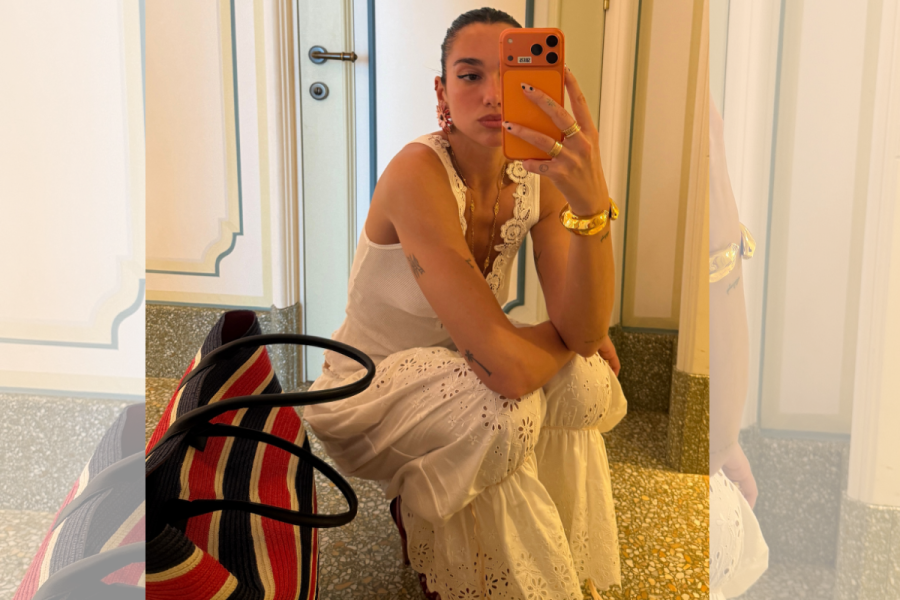
Dua Lipa has taken one of summer 2026's prettiest trouser trends back to a surprisingly political starting point. On 16 August, the Grammy-winning Levitating singer stepped out in Portofino, Italy, wearing Chloé's white Fluid Drawstring Trousers, a billowing, ribbon-tied design that echoes the bloomers adopted by women's dress reformers in 1851.
What reads as a romantic holiday outfit in 2026 closely resembles a 175-year-old silhouette that once made women targets of public ridicule. The original bloomer costume was promoted as a practical alternative to restrictive Victorian dress, but the backlash became so intense that some women's rights campaigners stopped wearing it so attention could return to issues including property rights and voting. That history turns Lipa's latest summer look into more than another celebrity take on boho dressing.
Dua Lipa Gives Bloomers a Chloé Upgrade
Lipa wore the look during a girls' trip celebrating her friend Ella Jenkin's upcoming wedding, later posting photographs from the trip on Instagram on 17 August. 'Gaaaaaals trip bc Ella's getting HITCHED,' the 'Houdini' singer captioned the carousel, which documented the group's Portofino getaway. Her wardrobe throughout the trip leaned into soft whites, lace and relaxed holiday dressing.
Dua Lipa, Portofino sokaklarında yazlık elbisesi ve büyük Chanel çantasıyla görüntülendi. pic.twitter.com/5eEpTShqvK
— Kulis Magazin (@kulis_magazin) August 19, 2026
For the bloomer-style look, Lipa paired a lace-trimmed Chloé top with the fashion house's Fluid Drawstring Trousers in 'Iconic Milk'. Chloé describes the £2,020 cotton trousers as featuring floral broderie anglaise, with contrasting ribbon ties cinching the legs below the knee to create a ruffled hem. She completed the outfit with flat brown sandals and an oversized Chanel tote, keeping the styling firmly in modern holiday territory.
Chloé does not officially call the trousers bloomers, and Lipa's version is not a literal recreation of the nineteenth-century garment. The 1851 reform outfit generally featured loose trousers beneath a shorter skirt or dress, while Lipa wore her trousers as the main event. The billowing Chloé trousers, cinched below the knee into exaggerated lace-trimmed cuffs, are a modern take on the bloomer silhouette that became a symbol of women's dress reform in the 1850s.
The 1851 Outfit That Became Political
The National Park Service traces the famous bloomer outfit to Elizabeth Smith Miller, who introduced the style before women's rights advocate and newspaper editor Amelia Bloomer made it widely known. Bloomer promoted dress reform through The Lily, a publication she edited for women, while arguing for clothing that allowed greater health, comfort and freedom of movement. The style became so closely associated with her campaigning that her surname eventually became the garment's name.
The reaction was not simply fashion criticism. The National Park Service says women wearing the new dress were ridiculed in both small towns and big cities, and that many eventually stopped because the clothing was distracting from campaigns for more fundamental rights. In writing later collected in Life and Writings of Amelia Bloomer, Bloomer distilled her position into a line that still sounds strikingly current: 'Our counsel to every woman is, wear what pleases you best.'
From Ridicule to a 2026 Fashion Revival
Bloomers have changed significantly since 1851, and the term later became associated with women's undergarments as well as reform dress. In summer 2026, however, longer bloomer-style trousers have resurfaced as visible outerwear alongside lace, petticoat dressing and the broader underwear-as-outerwear trend. The result is a silhouette that now sits comfortably in celebrity street style, despite the hostility attached to its earliest public appearance.
That contrast is what gives Lipa's Portofino outfit its deeper fashion history. A shape once associated with women demanding greater freedom to move, and mocked for challenging expectations of how women should dress, now appears in luxury fashion with a four-figure price tag. The garment has evolved, but 175 years later, its return still points back to a moment when something as ordinary as a pair of loose trousers became part of a much bigger argument about women's autonomy.