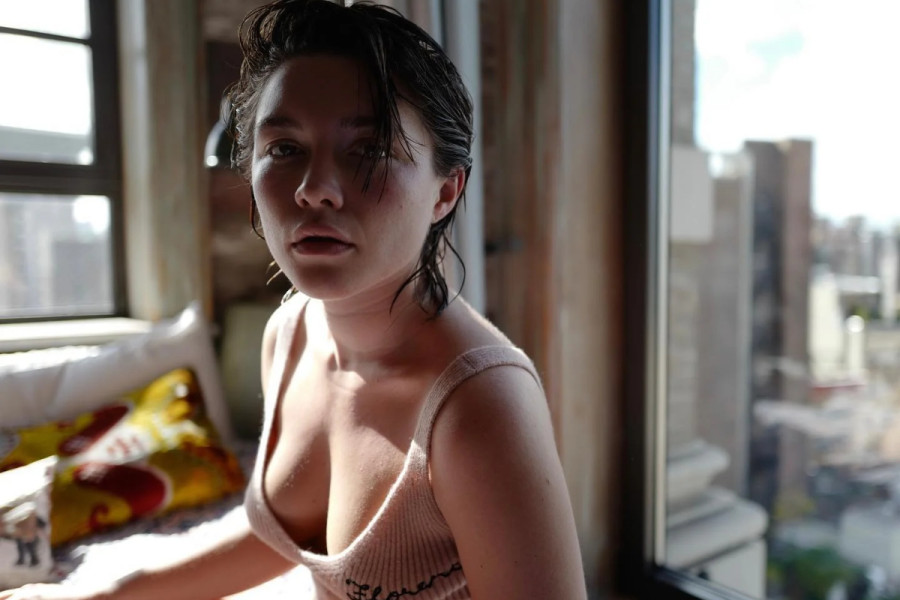
Florence Pugh has opened up about the difficult themes at the heart of East of Eden, arguing that women can be left to deal with the consequences of violence while facing criticism when they speak out about it.
The actor was discussing her role as Cathy Ames in Netflix's new adaptation of John Steinbeck's classic novel when she reflected on the experiences of women and the way stories about violence can be interpreted. Pugh said: 'We are dealing with very violent crimes that for some reason we are allowed to move on from, and women have to bear the consequences of that, and if they shout out about it, they're problematic.'
Her comments add a contemporary dimension to a character who has been debated by readers for decades. In Steinbeck's 1952 novel, Cathy is a deeply troubling figure whose actions cause enormous harm, while Zoe Kazan's new adaptation places greater emphasis on her inner life and perspective.
Pugh's Modern Reading of Cathy
Pugh's comments are particularly interesting because Cathy is not traditionally presented as a straightforward victim in East of Eden.
Steinbeck depicts her as manipulative and capable of calculated cruelty, and her actions towards the people around her are central to the novel's exploration of good and evil. That has led many readers to interpret her as an inherently sinister character rather than someone whose behaviour should primarily be understood through the violence she experiences.
The new Netflix series, however, deliberately takes a different approach.
Kazan, who wrote and executive produced the seven-episode adaptation, has said she wanted to find 'softness and tenderness and humanity' in Cathy without making excuses for her or fundamentally changing the character.
That distinction is important. The series is not simply presenting Cathy as innocent. Instead, it is giving audiences more access to her experiences and asking them to consider how her circumstances, choices and relationships shape the woman she becomes.
Pugh has embraced that complexity, making Cathy the centre of this new interpretation of Steinbeck's story.


Why the 'Problematic' Label Matters
The most revealing part of Pugh's comments is arguably her suggestion that women can be labelled 'problematic' when they speak openly about violence. Her point introduces a broader question into the adaptation: what happens when women refuse to remain quiet about the consequences of harmful behaviour?
That does not necessarily mean Cathy's actions should be excused. Rather, Pugh's interpretation invites viewers to consider the wider circumstances surrounding female characters and whether their experiences are given the same attention as their actions.
It also helps explain why the new adaptation has attracted such different reactions from readers familiar with the original novel.
Some readers have argued that Cathy's lack of empathy and willingness to manipulate others are fundamental to Steinbeck's character. Others are more interested in the possibility of understanding what lies beneath that behaviour.
The disagreement is significant because Kazan has explicitly said the series is not intended to be a completely faithful reproduction of the small section of the novel it adapts. Netflix describes it as a 'fresh interpretation' of Steinbeck's work, with Cathy at the centre of the story.
Cathy's Story Is Also Told Through Fashion
For a series built around a woman constantly changing her identity and circumstances, costume plays a major role in communicating Cathy's journey.
British Vogue recently spoke to costume designer Kirsty Cameron about the wardrobe created for Pugh's character. Cameron explained how Cathy's clothes change as she moves through different stages of her life, from the dresses chosen for her as a child to the more elaborate clothes associated with her relationships and eventual transformation into Kate.
One particularly striking costume was designed to contrast femininity with violence, with Cameron explaining that the dress needed to retain a feminine quality while also communicating the damage Cathy experiences.
That visual contrast mirrors the larger question raised by Pugh: how can a woman's vulnerability, choices and wrongdoing exist alongside one another without reducing her to a single label?
East of Eden Release
Pugh stars opposite Christopher Abbott as Adam Trask and Mike Faist as Charles Trask, with Hoon Lee, Ciarán Hinds and Martha Plimpton also among the cast.
The seven-episode limited series has been created and written by Kazan, with the story following Cathy and the Trask and Hamilton families across generations in California's Salinas Valley.
All seven episodes of East of Eden are due to arrive globally on Netflix on 1 October 2026.
For Pugh, the fascination with Cathy appears to lie in refusing to make her easy to understand. Her comments about women bearing the consequences of violence and being branded 'problematic' when they speak out add another layer to that interpretation.
And while viewers may continue to disagree over whether Cathy should be viewed primarily as a villain, a victim or something more complicated, Pugh's performance is clearly designed to make audiences question where those labels begin and end.