Mina Chan, a Japanese K-pop influencer and prominent ENHYPEN fan, has died aged 26, leaving followers mourning her loss while questioning how online criticism can spiral into relentless harassment. Her death on 5 August has drawn particular attention because it came days after she publicly apologised for a controversial interaction at an ENHYPEN concert in the US.
Chan had built a sizeable online following around K-pop, beauty, fashion and lifestyle content, with reports saying she had more than 80,000 followers on TikTok. She lived in South Korea and was a familiar presence at ENHYPEN events, including fan-signs and concerts. Following news of her death, fans have shared tributes while others have condemned the online abuse she reportedly faced.
The circumstances have also reignited an uncomfortable debate within K-pop fandom: when does criticism of a fan's behaviour cross the line into targeted harassment?
The Concert Incident That Changed Everything
The backlash surrounding Chan reportedly began after an ENHYPEN concert in the United States in July.
According to reports, Chan attempted to have member Sunoo pass flowers to Ni-ki, the Japanese member of the group. What may have appeared to be a small gesture became a major point of discussion among some fans, with critics accusing Chan of overstepping boundaries and seeking an unusually personal interaction with the group.
Chan did not ignore the criticism. On 31 July, she published a lengthy apology on X, acknowledging that she had misjudged her relationship with the members.
'I feel like my actions ended up taking advantage of Sunoo's kindness,' she wrote, apologising to Sunoo and his fans.
She also reflected on her repeated attendance at ENHYPEN fan-sign events, writing that she had 'deluded myself into thinking I was closer to the members than I actually was'.
Her statement was significant because she accepted responsibility for the incident rather than presenting herself solely as a victim of online criticism. Yet reports indicate that the backlash continued even after her apology.
The Online Backlash Continued
The controversy became much bigger than the original concert interaction.
Reports have described Chan receiving hateful messages from members of the ENHYPEN fandom after the incident. Following her death, some fans returned to her social-media pages to leave messages of support. In contrast, others criticised the behaviour that had allegedly contributed to the hostile atmosphere around her.
The reaction has exposed a familiar problem in highly engaged online communities. K-pop fandoms can provide friendship, a sense of belonging, and shared interests, but the same intense loyalty can sometimes turn disagreements into personal attacks.
Chan's case is particularly troubling because the criticism reportedly continued after she had already apologised.
What Ni-Ki Said And What We Know
Another layer of the controversy involves comments made by ENHYPEN member Ni-ki during a later livestream.
Some fans interpreted his remarks as referring to the earlier incident involving Chan, which prompted further discussion and, in some cases, additional criticism directed towards her. However, this remains an area where caution is essential.
There is no confirmed evidence that Ni-ki was specifically talking about Chan, and neither he nor BELIFT LAB has publicly established that connection. Other online discussions have suggested his remarks could have been about fans more generally rather than Chan herself.
That distinction matters. With social-media controversies moving rapidly, assumptions can quickly become accepted as facts, potentially creating another wave of harassment.
Her Family Asks For Kindness
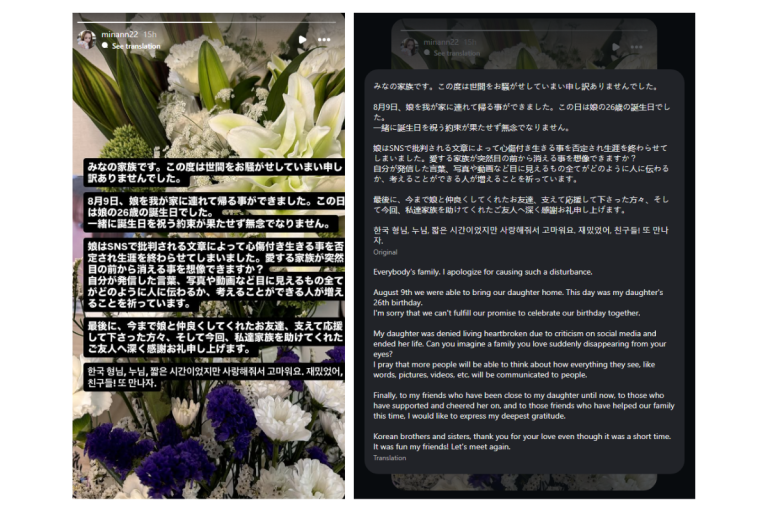
Chan's younger sister reportedly confirmed her death through an Instagram Story, describing her as someone kind and warm to everyone she met and asking people to keep her in their thoughts and prayers.
Police in Seoul are investigating the circumstances surrounding Chan's death. Reports say authorities were alerted after viewers became concerned during her TikTok livestream, before police later found her at her home.
Importantly, while Chan's death occurred amid reported online harassment, it would be misleading to claim that the fandom backlash alone caused it. The circumstances surrounding a person's death are complex, and the investigation remains ongoing.
A Reckoning For K-Pop Fandom
The tragedy has nevertheless forced fans to confront the consequences of online behaviour.
Chan's story is not simply about one concert, one apology or one fandom dispute. It is about what happens when an individual becomes the focus of thousands of opinions, reposts and comments, with criticism potentially following them from one platform to another.
For a community built around artists and music, the question now is whether protecting idols should ever involve attacking fellow fans. Many mourners appear to believe the answer is no. Tributes to Chan have described her as kind and passionate, while critics of the alleged harassment have called for greater restraint within fandom spaces.
The most important lesson may be a simple one: disagreement does not require dehumanisation. Fans can challenge behaviour, discuss boundaries and hold one another accountable without turning criticism into a campaign against an individual.
As Mina Chan's followers continue to mourn, her death has become a painful reminder that behind every fan account, comment and viral post is a real person — and words posted online can travel much further than anyone expects.