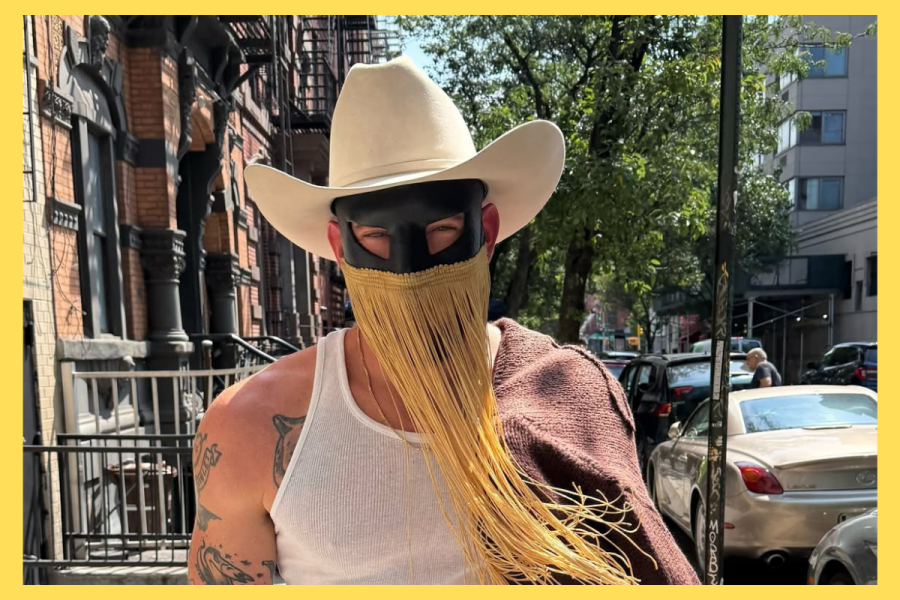
Orville Peck has never once taken his mask off in public, not for an album cycle, not for a Broadway run, not even now, stripped down almost entirely for the September cover of Playgirl.
The fringed cowboy mask stayed exactly where it always is, perched over his eyes and nose, while everything else came off for a shoot photographed by Anna Garbowska at The Standard High Line in New York.
Fans are thrilled and, increasingly, a little tired of asking the same question. The shoot makes Peck the first openly gay singer to front Playgirl's cover, released days before Mule, an album built around a 2023 overdose he nearly did not survive.
Most reactions split into three camps: people celebrating the milestone, people begging him to finally show his face, and people wondering if anyone still reads Playgirl in the first place.
Will Orville Peck Ever Show His Face?
'I don't understand the face covering, everyone knows who he is now,' wrote one fan under the shoot. Another was blunter still: 'that mask thing is so stupid.'
I don’t understand the face covering, everyone knows who he is now.
— Just Call Me Steve 🇺🇸 (@IAMSteveCox) September 15, 2026
In an age when Reddit sleuths can unmask a catfish in an afternoon, keeping the same disguise for most of a decade just looks odd to a lot of fans now.
Peck has answered versions of this question before without ever really answering it. Early in his career, he told NPR the mask 'just appeared on my face one day, and now I can't get it off'. Years later he told NBC News it tracks with his own confidence, adding that his first album was when he 'really needed' it.
“I think the idea of a cowboy is such a trope of masculinity. What’s sexier than a little bit of rebellion?” - Orville Peck, #Playgirl September cover starhttps://t.co/WhlGhOC4ER
— PLAYGIRL (@playgirl) September 12, 2026
📷 Anka Garbowska#OrvillePeck pic.twitter.com/ggEGPkCLD7
Whether that still holds at album four, with the mask the last thing left on in a Playgirl shoot, is exactly what fans are arguing about now. It also matters for a genre that has long been uneasy with anything that doesn't fit a straight, masculine mould.


Does Mule Finally Silence the 'Style Over Substance' Critique?
'HE'S SO COOL I WISH HIS MUSIC WAS GOOD' is the backhanded compliment doing laps of social media this week. On the surface, it captures a real divide between Peck's elaborate visual world and the question of whether his songs are as impressive once the fringes come off.
HES SO COOL I WISH HIS MUSIC WAS GOOD
— ícaro (@_schschsch) September 16, 2026
But the timing works against that. Peck has called Mule his most candid record, built around the worst year of his life. Looked at that way, the Playgirl cover is not a distraction from the music. It goes with an album about the gap between the persona and the man underneath it.
Is Anyone Still Reading Playgirl Anyway?
The magazine itself is getting dragged too. 'Is Playgirl even still relevant? Does anyone buy Playboy or Playgirl anymore, even in digital form?' asked one user, and it is a fair question about a title a lot of people assumed folded years ago.
Is Playgirl even still relevant? Does anyone buy playboy or playgirl anymore? Even in digital form?
— Rob (@RCWC1964) September 16, 2026
The cover and spread lean hard into Playgirl's old playbook: high-contrast black-and-white shots, chaps and fringe as the only real costume, Peck posed like a queer cowboy pin-up rather than a conventional country star.
A genuinely historic cover can still feel diminished if the magazine itself seems like a relic, and that argument is, fittingly, still playing out in the comments.
Backstage with Orville Peck, the first openly gay country music star to grace the cover of #Playgirl#OrvillePeckhttps://t.co/WhlGhOC4ER pic.twitter.com/FvTVPc93K5
— PLAYGIRL (@playgirl) September 15, 2026
When the Man Turned Mule tour opens on 18 September, audiences will not be looking for a face reveal. Instead, they'll ask why anyone thought the face mattered more than the songs.