
The 2026 Met Gala arrived with its usual spectacle — flashes, fabric, fantasy — but this year, something felt slightly different. Beneath the usual red carpet theatrics, there was a clear sense that a new kind of designer presence was shaping the conversation. Not a legacy fashion house dominating through heritage, but an independent couturier quietly, then very loudly, taking over the narrative.
That designer was Robert Wun.
What made his showing so hard to ignore wasn't just the scale of it — though dressing eight guests is no small feat — but the way each looked felt like its own self-contained world. At a night themed 'Fashion Is Art', Wun didn't just interpret the brief. He stretched it, bent it, and in some cases made it feel almost cinematic.
The Met Gala, Through Wun's Lens
Wun has always worked like a storyteller first, designer second. His rise through couture over the past few years has been steady, but the Met Gala has become his most visible stage. This year, that stage expanded dramatically.
He dressed a roster that included Lisa, Beyoncé Knowles-Carter, Naomi Osaka, Jordan Roth and others — each look so distinct it felt less like a collection and more like multiple parallel narratives unfolding at once.
What's interesting about Wun's approach is that there's no sense of a rigid formula. In his own words, it's collaborative from the beginning. Clients arrive with ideas already forming, sometimes even before sketches exist. That openness is perhaps why the results feel so alive.
Lisa: Stillness, Strength and Spectacle
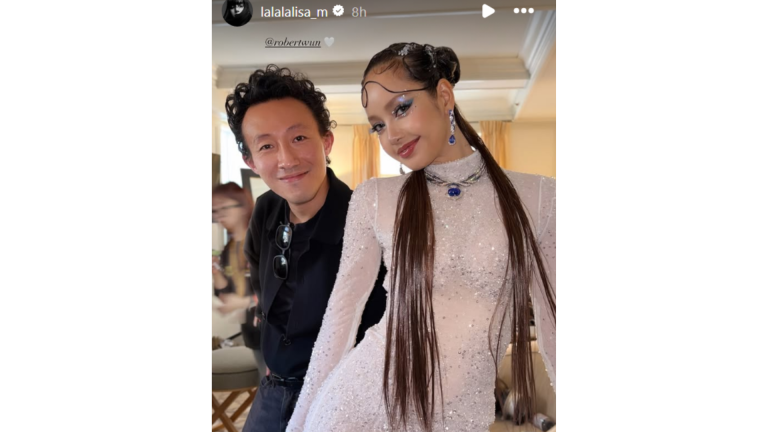
Lisa's appearance was one of the night's defining moments — not because it shouted the loudest, but because it didn't need to. Arriving in a sheer ivory gown layered with intricate crystal work and a sculptural veil, she moved through the Met steps with a kind of calm precision that contrasted beautifully with the garment's complexity.
The technicality behind it was almost absurd: thousands of hours of embroidery, a structured veil weighing several kilograms, and 3D-scanned arm pieces inspired by traditional Thai dance positions. But none of that overpowered the final image.
What stood out was Wun's observation that Lisa simply carried it.
'When she had to be on the carpet by herself, she literally just owned it like a champion,' he said. And that really is the point — the look only worked because she didn't treat it like armour. It became second skin.
Beyoncé: Scale, Stars and Spectacle
If Lisa's look was about control, Beyoncé's was about expansion.
During the event, she appeared in Wun's 'Stargaze Gown', a black-and-gold crystal piece that seemed to shift depending on how the light fell on it. The concept was rooted in a simple but striking idea — the view of Earth from above at night, like looking down from a plane and seeing entire coastlines lit up like constellations.
It sounds poetic, almost abstract, but the execution was grounded in extraordinary detail: millions of stitches, thousands of hours of handwork, and a level of precision that only really reveals itself when you see it up close.
What's most striking is how involved Beyoncé was in the process. Wun described multiple rounds of sketches and conversations, with references even coming directly from her own saved images. It wasn't a passive collaboration — it was iterative, almost conversational.
And that may be why the final look felt so resolved. Nothing about it felt accidental.
A Designer Working at Full Scale
Beyond the two headline moments, Wun's presence stretched across the Met Gala like a thread connecting different ideas of transformation.
Naomi Osaka's sculptural red reveal, Jordan Roth's living sculpture silhouette, Audrey Nuna's UV-reactive coat, Nichapat Suphap's kinetic sculptural hands — each one felt like an experiment in what clothing can do when it stops trying to be purely decorative.
Even the more structured looks, like Ananya Birla's tailored ensemble or Gustav Magnar Witzøe's illusion-based suit, carried a sense of narrative intention rather than simple styling.
There's a risk, of course, when a designer works at this scale: that the work becomes about spectacle over substance. But Wun's strength lies in balancing both. His garments are visually loud, but conceptually anchored.
The Bigger Shift
Perhaps what makes Wun's rise so significant is not just the celebrities he dresses, but the space he now occupies within the Met Gala ecosystem itself.
This is no longer just about red carpet placements or viral images. It's about authorship. Whose vision defines the night? Whose ideas linger after the flashbulbs fade?
For a designer who once spoke about looking up to these moments as a fashion student, the shift is quietly monumental.
The Met Gala has always been about interpretation — of theme, of identity, of art history itself. But in 2026, Robert Wun didn't just interpret it. He helped define it.
And that, more than anything, is what signals a new generation stepping fully into view.