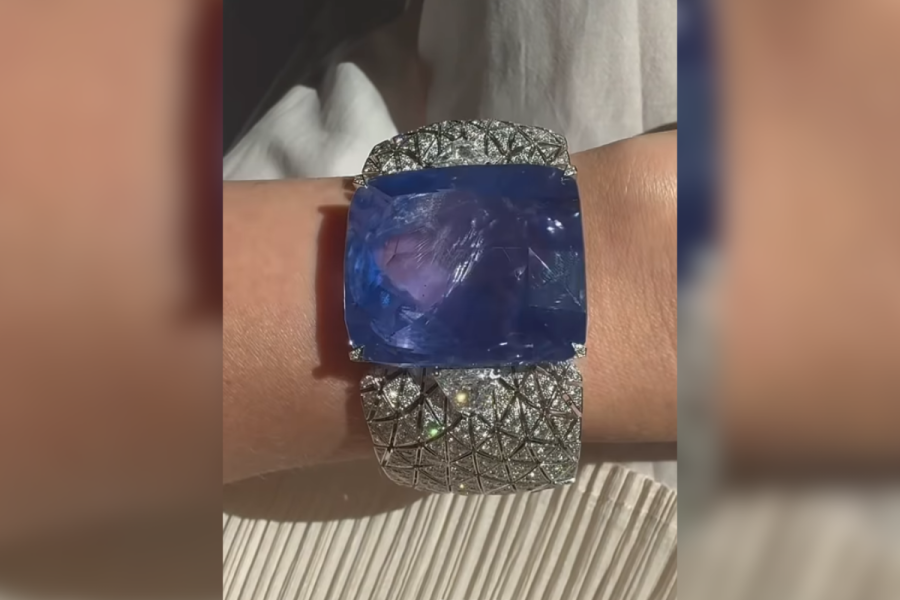
A nearly 200-carat sapphire once owned by Russia's imperial family has sold for $4.9 million (£3.7 million) at a Geneva auction, more than twice the top end of its pre-sale estimate. The 197.80-carat blue Ceylon sapphire achieved 4.122 million Swiss francs at Sotheby's Royal & Noble Jewels sale on 11 November.
Before the auction, it had been expected to sell for between 850,000 and 1.7 million Swiss francs, equivalent to about $1 million to $2 million (£755,700 to £1.5 million). A private collector placed the winning bid, but their identity has not been made public. The gemstone was offered in a diamond and rock crystal bracelet made by Cartier, with the sapphire as its centrepiece.
The Romanov Connection
The sapphire is linked to Dowager Empress Maria Feodorovna, the wife of Emperor Alexander III and mother of Nicholas II, the last emperor of Russia. Its royal history has been connected to the grand celebrations held by the Romanov family during the 19th century.
Sotheby's sale announcements linked the jewel to the 1903 Winter Palace Ball. However, the auction house's detailed lot notes and accounts from royal historians identify the portrait associated with the sapphire as depicting Dowager Empress Maria Feodorovna wearing it at a costume ball held at Vladimir Palace in St Petersburg in January 1883.
The Vladimir Palace ball was among the grand gatherings attended by members of the imperial family and Russian aristocracy. Its connection to Maria Feodorovna places the sapphire within the social history of the Romanov court, where elaborate jewellery formed an important part of royal dress and public appearances.
Maria Feodorovna remained a prominent figure in the imperial family until the monarchy's collapse. Her association with the sapphire gives the gemstone historical importance beyond its considerable size and value, connecting it to one of Russia's most recognisable royal dynasties.

From Imperial Russia to the Auction Block
The sapphire's history began before it reached Russia. It is believed to have originated in the Mughal Empire in South Asia before entering the Russian imperial jewels during the 19th century. Its route between royal collections and private ownership reflects how valuable objects moved across borders during periods of political change.
Following the Russian Revolution, the Soviet government commissioned an inventory of the former imperial jewels between 1924 and 1926. The sapphire was included among the gemstones subsequently sold off anonymously as part of the government's dispersal of the collection.
The Sapphire's Journey Through Private Collections
Sotheby's catalogue traces the stone's later ownership and auction history, including its acquisition by opera singer and collector Ganna Walska in 1927. It subsequently appeared at Sotheby's auctions in New York in 1971 and Geneva in 1992, before returning to the auction house this November.
The sapphire is now mounted in a Cartier bracelet created around 2015. The design combines diamonds with an interchangeable rock crystal centre, placing the historic stone in a more contemporary setting while retaining its prominence.
Its latest sale brings the jewel back into public view and adds another chapter to a history spanning the Mughal world, the Russian imperial court and private collections. More than a century after Maria Feodorovna wore it, the sapphire has changed hands again, this time for 4.122 million Swiss francs.