
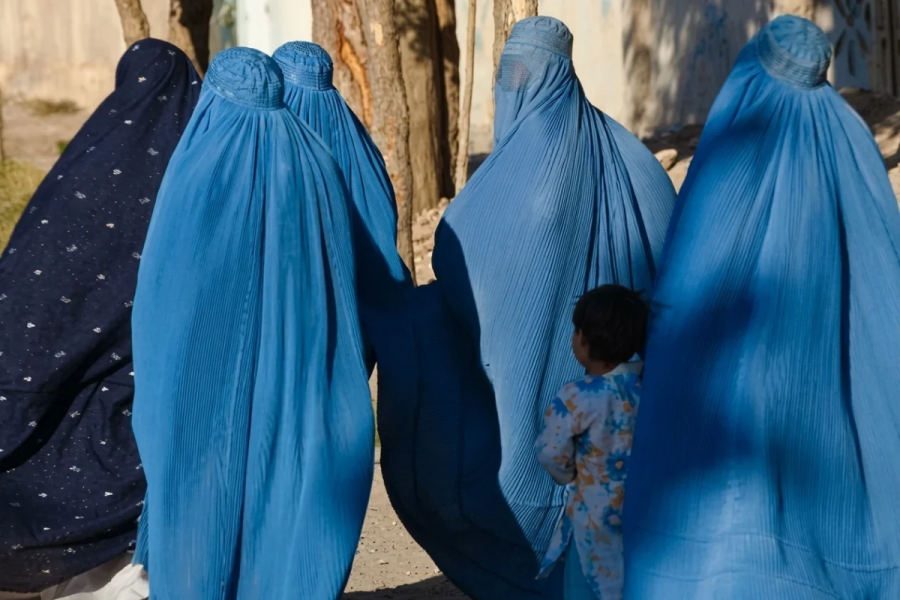
Taliban authorities in Afghanistan's northern Balkh province have reportedly ordered hospitals, clinics and other public institutions to stop using women's real names in official documents, replacing them with the term 'Bibi'. The instruction extends to medical records and prescriptions, raising concerns over women's identities and the potential consequences for healthcare.
The order was issued in May by morality police officials, who instructed healthcare facilities and other public offices to use the generic form of address instead of recording women's given names. The restriction applies to female patients across hospitals, private medical practices, and clinics in the province.
'Bibi' is traditionally used as a respectful form of address for an older woman or grandmother. Its compulsory use for women of all ages, however, has raised concerns among rights advocates, particularly because it would replace their individual names in official records.
Concerns Over Women's Identity
Afghan women's rights activist Lalah Osmany, who is based in Germany, has criticised the practice as part of a wider effort to erase women's individual identities. She said testimonies from women, doctors, and civil society activists also indicated that some women were being addressed using degrading animal-related terms, including 'goat' and 'cow'.
Afghan women have literally lost all their rights. What’s even left for them now?
— Chulbuli (@BetiGoneBad) November 27, 2026
So, the Taliban has banned women’s name in any official documents… every woman is now “Bibi” (means grandma), “goat” or “cow”
These men are so scared of women that now they are erasing them. pic.twitter.com/J8hOgAYNUy
Osmany argued that replacing women's names with such labels reduces them to objects or possessions rather than recognising them as individuals.
'When a regime replaces a woman's name and gives her one of an animal, it is stripping her of her human soul and reducing her to a mere biological creature or the property of a man,' she said.
The reported restriction comes against a backdrop of increasingly severe limits on Afghan women's participation in public life since the Taliban returned to power in 2021. The loss of their names from official records raises further concerns about their recognition as individuals within public institutions.




Scope of the Directive Remains Unclear
EL PAÍS has not established whether the instruction was formally issued as a written decree or how consistently it has been enforced across Balkh province.
It is also unclear whether the restriction applies to every category of official documentation or is primarily enforced in medical records, prescriptions, and paperwork handled by government institutions. There is no established evidence that the measure has been extended nationwide.
The details of the directive emerged through a joint investigation by Afghan media outlet Zan Times and The Guardian. Osmany's account of the degrading terms used for women, as well as her criticism of the policy, was also documented in an interview with Spanish newspaper EL PAÍS.
Activist Warns of Potential Medical Errors
Beyond the implications for women's identities, the use of a single generic term across medical records could create practical problems for healthcare workers and patients.
If multiple women are registered under the same name, distinguishing between individual patient files could become more difficult, potentially increasing the risk of errors involving prescriptions, diagnoses and treatment.
Osmany warned that the practice could have serious consequences for patient safety.
'Imagine a hospital where dozens of prescriptions and medical records are filed under the same name – Bibi – or a number. The risks of making medical errors are huge,' she said.
The potential risks add another concern to the restrictions already affecting women's access to healthcare in Afghanistan, where separate Taliban measures have placed limits on medical treatment and women's participation in healthcare training.