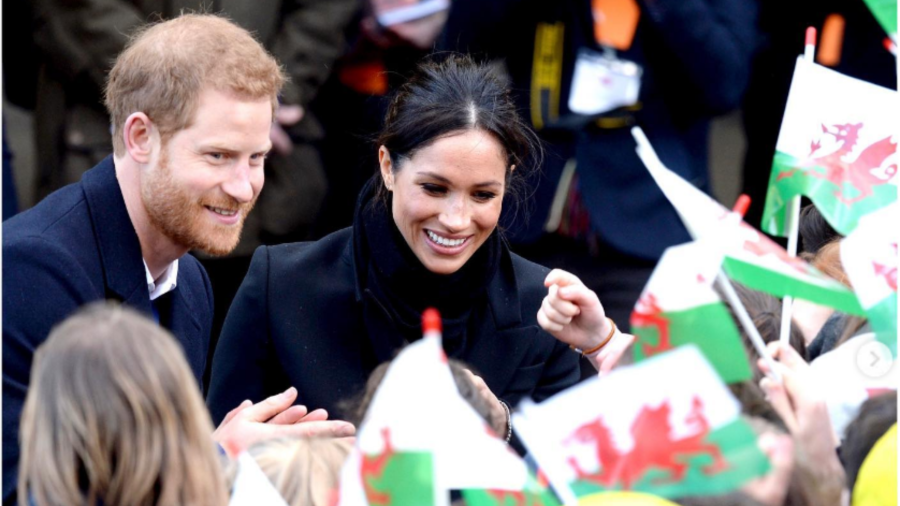
When Prince Harry and Meghan Markle travel to Australia next month, it is always going to attract attention. What perhaps wasn't expected was how quickly the conversation would turn to money—and who, exactly, should be paying for what.
At first, it felt like background noise. A few questions here and there about security, logistics, and the usual details that tend to follow high-profile visits. But over the past week, that quiet curiosity has tipped into something more pointed. Not outrage, exactly—but a definite sense of scepticism.
It's hard to separate that reaction from the current mood. Across Australia, households are still feeling stretched, and there's a heightened sensitivity around how public funds are used. Against that backdrop, even the hint that taxpayer money might be involved has been enough to spark debate—regardless of whether that assumption holds up.
A petition that struck a nerve
The petition itself is fairly straightforward: no public funding, no official support, and no blurred lines. Yet the speed at which it gathered more than 32,000 signatures suggests it tapped into something deeper than a one-off complaint.
There's a practical argument at its core — that a visit framed as private should be treated as such — but there's also a more emotional undercurrent. A feeling, perhaps, that rules should apply evenly, regardless of profile or status.
Interestingly, not everyone signing it is necessarily opposed to the visit. For some, it's less about Prince Harry and Meghan Markle themselves and more about what their presence represents in a system that still feels, at times, uneven.
A familiar grey area
This isn't the first time the couple have found themselves in this kind of in-between space. Since stepping back from royal duties, they've operated in a lane that's neither fully private nor traditionally royal—and that ambiguity tends to follow them wherever they go.
On paper, the distinction is clear enough. In practice, it's messier. Their visits still draw crowds, require coordination, and generate the sort of attention that usually comes with official backing. So when questions around security arise, it's not always obvious where responsibility begins and ends.
That lack of clarity is often where frustration creeps in. Not necessarily because people expect a particular answer, but because the answer itself can feel elusive.
Sussex response pushes back
A spokesperson for the couple was quick to shut down the speculation, describing the entire debate as 'a moot point' and confirming that the trip will, in fact, be privately funded.
The response didn't just clarify—it carried a sharper edge than usual, hinting at irritation over how quickly assumptions had taken hold. There was also a suggestion that the petition itself might be fuelling a narrative that doesn't quite align with reality.
Still, by that stage, the conversation had already gathered momentum. And once a story like this starts to circulate, it rarely disappears overnight.
Spotlight on a Sydney appearance
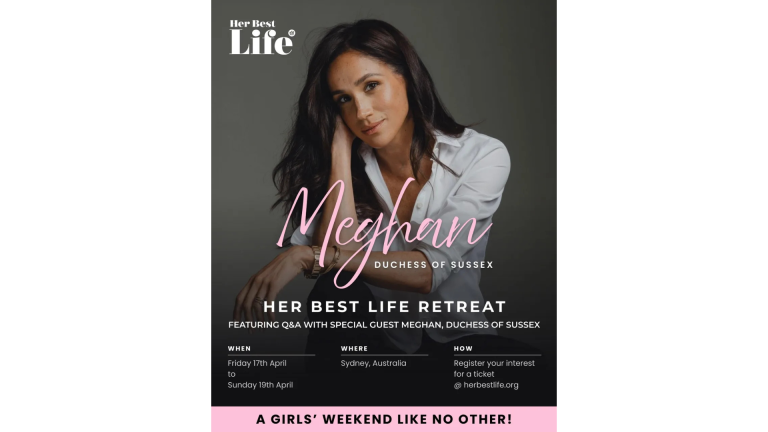
At the centre of the visit is Meghan Markle's appearance at the 'Her Best Life Retreat', a three-day event running from 17 to 19 April in Sydney. It's the kind of offering that feels very in step with the current moment—part wellness, part networking, part aspirational escape.
Tickets have already sold out, with around 300 guests expected to attend. For those who secured a place, the draw is clear: proximity, access, and the chance to engage with Meghan in a more intimate setting than a traditional public appearance.
There's also something telling about the format itself. These sorts of events — polished, experience-led, and personality-driven — have become increasingly common, particularly as the lines between celebrity, influence and business continue to blur.
Not quite picture-perfect
That said, the lead-up hasn't been entirely seamless. Reports suggest the hotel hosting the retreat is still very much in the final stages of preparation, with construction ongoing in parts of the property.
Some recent visitors have described it as a 'work in progress', which, depending on your perspective, is either expected ahead of a launch or slightly at odds with the luxury positioning.
Then there's the beach itself. Coogee is, of course, one of Sydney's most recognisable coastal spots, but recent environmental issues have added an unexpected wrinkle to the setting. It's not necessarily a dealbreaker, but it does take the shine off what's being presented as a carefully curated escape.
More than just a visit
What makes this story linger isn't just the petition or the event — it's the way the two intersect — a high-profile visit, a luxury retreat, and a public conversation about funding all unfolding at once.
For Prince Harry and Meghan Markle, that kind of overlap has become familiar territory. Their presence tends to invite not just attention, but interpretation.
And perhaps that's the real takeaway here. Not whether the visit is publicly funded — that question appears to have been answered — but why it resonated in the first place.
Because in the current climate, it doesn't take much for a routine trip to become something more. A talking point. A flashpoint, even.
As April approaches, the focus may well shift back to the event itself—the setting, the guests, the carefully staged moments. But the conversation that's already begun is unlikely to disappear entirely.
In the end, this isn't just about a visit to Australia. It's about how that visit is read—and what people bring to it before it even begins.