For more than 20 years, the name Banksy has been as famous as his art. From London's East End walls to abandoned buildings in New York, his stencilled works have become well-known around the world. Their distinctive blend of satire, politics, and social criticism makes them instantly recognisable.
And yet, no one knew who he really was. That mystery has always been part of the thrill. He's an artist with an anonymous voice who spoke out on important issues without ever showing his face.
However, that mystery might finally be cracking. A recent major investigation claims to have traced Banksy's real identity and revealed that he may have been hiding in plain sight all along under one of Britain's most common male names.
If true, this would be one of the most remarkable unmaskings in modern art history. Not surprisingly, this has sparked plenty of debate.
Could This Be Banksy's True Identity?
Reuters says that Banksy is most likely Robin Gunningham, a Bristol-born graffiti artist who was born in 1973. The report suggests that in 2008, he legally changed his name to David Jones — a name so common it could vanish in a crowd.
Investigators pieced together travel records, court documents, and eyewitness accounts. They even linked his movements to when new murals popped up across the globe, from London to Kyiv, Ukraine. One of the more compelling pieces of evidence is a hand-written confession linked to a 2000 arrest in New York, which appears to match Gunningham's profile.
Banksy's team, through long-time lawyer Mark Stephens, has been careful in their response. The artist 'does not accept that many of the details contained within your enquiry are correct', Stephens told Reuters. He emphasised that revealing Banksy's identity could also put the artist at risk.
Notably, while the investigation may be compelling, it hasn't been officially confirmed.
Themes Behind His Murals
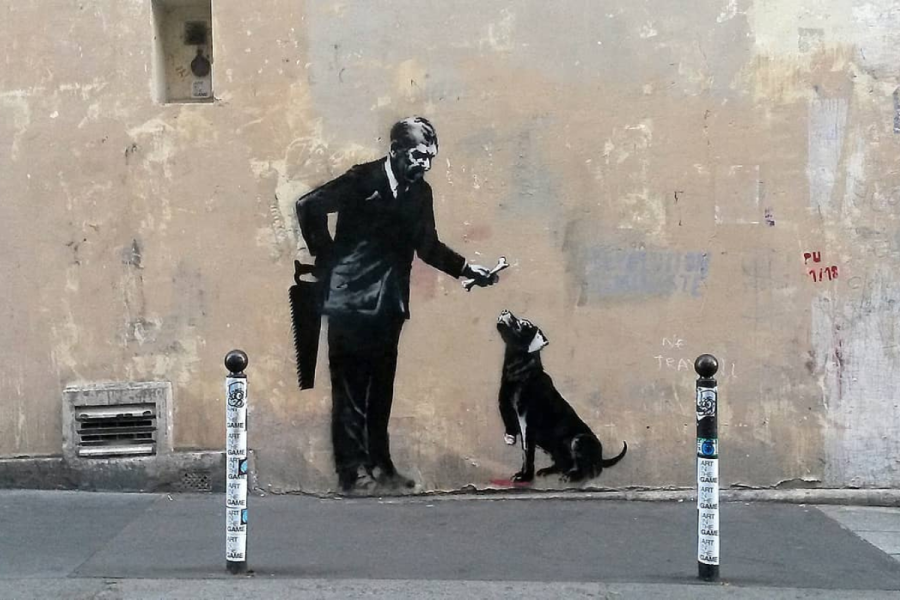
Regardless of who's behind the spray paint, Banksy's work speaks for itself. His stencils are simple yet powerful, often appearing in public spaces where anyone can stumble across them.
Who could forget Girl With Balloon, featuring a girl letting go of a heart-shaped balloon, or the infamous moment in 2018 when this exact artwork partially shredded itself at a Sotheby's auction? Then there's Kissing Coppers, the mural of two policemen sharing a kiss, which challenged authority and sparked conversation across the UK. More recently, his Royal Courts of Justice mural provoked a debate on justice and power.
His art isn't just graffiti. It's commentary. Banksy isn't afraid to take risks or try out new media, as seen in projects like the 2015 dark amusement park Dismaland and the film Exit Through the Gift Shop. And he always keeps that satirical edge.
Whether it's a rodent parachuting onto a building or a poignant social critique, his work consistently nudges people to think differently about the world.
The Artist's Global Influence
The mystery of Banksy has helped turn him into a global symbol. His anonymity has been a big part of his appeal, which is a reminder that art doesn't need a face to be relevant. His works are accessible, often appearing in ordinary urban spaces, as if they are gifts for anyone who passes by.
The fact that someone ordinary — like 'David Jones' — could be behind these impactful pieces makes the story even more interesting.
More importantly, Banksy has inspired countless street artists worldwide and changed how the public interacts with urban spaces. His name alone carries weight, whether it's real or not. It shows that the line between mainstream art and public expression can blur in ways that challenge conventions.
What Happens Next?
If Banksy's identity is widely known, the impact on the art industry could be significant.
His works have become more valuable over time because aside from the messages they convey, no one knows who the artist is. Auctions have become major events with his pieces selling for millions. If his identity is confirmed, collectors may see his art in a different light, which could change its market value.
But beyond money, it reignites the conversation about privacy, artistic freedom, and cultural influence. Keeping an artist anonymous is more than just about secrecy. It's also about protecting the ability to challenge society without putting oneself at risk.