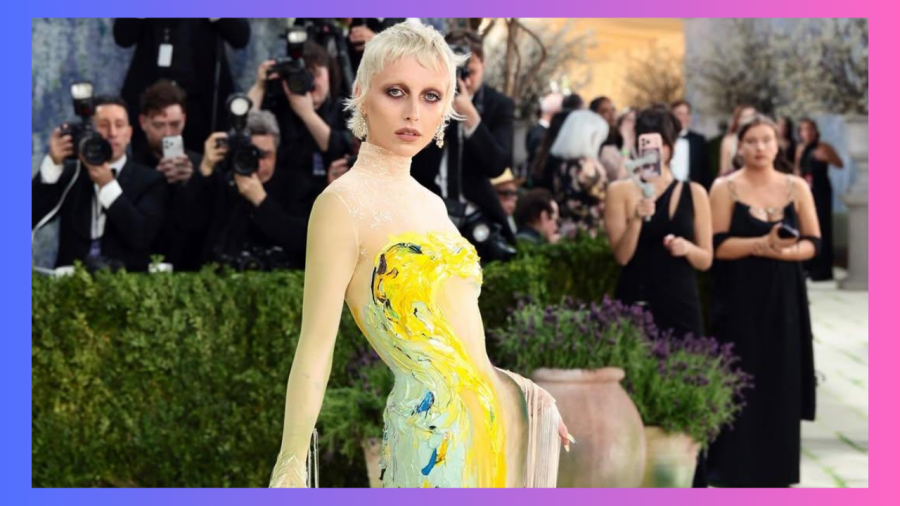
Emma Chamberlain did not simply arrive at the 2026 Met Gala in a statement dress. She looked as though she had stepped straight out of a painting in a custom Mugler gown hand-painted by artist Anna Deller-Yee.
The intricate painting process alone took 40 hours, while the finished creation needed four days to dry. It also incorporated more than 150 metres of fabric, making the gown as much a work of art as it was a red-carpet look.
A Dress Designed as Living Art
For the Met Gala's 'Fashion Is Art' dress code, Chamberlain worked with Mugler creative director Miguel Castro Freitas and stylist Jared Ellner on a look that treated the body almost like a canvas. The gown was constructed by the Mugler atelier in Paris before Deller-Yee began painting directly onto the finished garments using fine-art materials.
She worked with around 30 base colours, building up the flowing surface with washes of yellow, blue, purple and mauve. The result was deliberately more than just pretty. Chamberlain has described being drawn to art with a slightly unsettling quality, and the gown was designed to carry that same emotional tension.
The 40 Hours Were Only for Painting
The headline-grabbing 40-hour figure refers specifically to Deller-Yee's painting process, not the total amount of work required to create the gown. Vogue reported that the artist spent 40 hours painting the look, while the finished gown took several days to dry. The larger project involved substantially more work, putting the total at 958 hours.
The Royal College of Art also detailed the extraordinary scale of the finished design. The gown featured a train with a nine-metre circumference, 880 lines of cascading ruffles and around 150 metres of fabric. After the painting and drying process, the gown was flown to New York for fitting, adding another crucial stage before Chamberlain could finally wear it on the Met carpet.
Emma's Father Helped Inspire the Look
The artistic concept also had a deeply personal connection to Chamberlain. Her father, Michael Chamberlain, is an oil and watercolour painter, and Emma has spoken about growing up in a creative household. That background made the 2026 theme particularly meaningful for her.
Speaking to Vogue, Chamberlain explained that the gown's artistic quality felt deeply connected to who she was. She described being drawn to its beauty while also appreciating a 'creepy, sort of ominous undertone'.
The colour treatment was intended to evoke the feeling of watercolour, while references to artists including Vincent van Gogh and Edvard Munch added another layer to the concept.
Mugler's Fashion History Was Woven Into It
Although the gown was a new creation, its design also looked backwards. Castro Freitas and the team drew inspiration from Mugler's archive, including the house's iconic 1997 butterfly design.
The reference helped connect Chamberlain's modern hand-painted gown to the fashion house's more theatrical history. That balance between archival fashion and contemporary art was particularly fitting for a Met Gala centred on the relationship between clothing and artistic expression.
Who Is Miguel Castro Freitas?
Castro Freitas became one of the most important figures behind Chamberlain's look after taking over as Mugler's creative director. He graduated from Central Saint Martins in 2004 and built his career through major fashion houses, including Dior, Yves Saint Laurent, Lanvin and Dries Van Noten.
He was appointed Mugler's creative director in March 2025 and officially joined in April 2025. For Chamberlain, the collaboration was also a relatively new creative relationship. She and Ellner met Castro Freitas during Paris Fashion Week before his first Mugler show, eventually developing the idea that became her Met Gala look.
A Met Gala Look Literally Made Like Art
Online, Chamberlain's appearance prompted plenty of discussion, with social-media users comparing the hand-painted gown to a painting or describing her as a living work of art. Those reactions were subjective fan responses rather than established facts, but they reflected exactly what the look was designed to achieve.
Behind the visual impact was an extraordinary amount of labour: 40 hours specifically spent painting, four days of drying, 30 base colours, 880 lines of ruffles and more than 150 metres of fabric.
In a Met Gala built around 'Fashion Is Art', Chamberlain's Mugler gown did more than reference the theme. It quite literally put painting onto the fabric, turning one of fashion's biggest red carpets into a moving canvas.