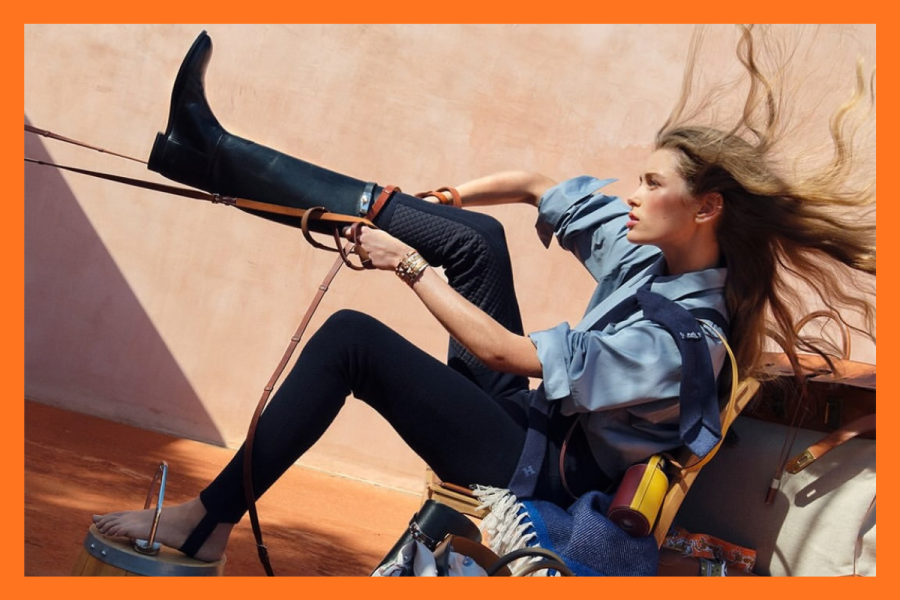
Hermès is putting its equestrian heritage in the spotlight for Fall Winter 2026, with a six-image 'Ride on!' visual series bringing reins and riding references into the luxury house's latest fashion presentation.
The imagery features both the women's and men's collections, placing ready-to-wear, leather goods, and footwear in settings built around unmistakable equestrian cues. The presentation draws a connection between Hermès' contemporary fashion offering and the craftsmanship that predates its emergence as a global luxury brand.


Hermès Puts Reins at the Centre of Its FW26 Story
The six photographs use reins and other riding-inspired details as visual threads running through the presentation of the Fall Winter 2026 collections.
Rather than presenting the equestrian references as an isolated styling idea, the 'Ride on!' series places them alongside clothing, leather goods and footwear, allowing the riding vocabulary to form part of the wider fashion narrative.
The connection is rooted in Hermès' history, with the house's relationship with the equestrian world dating back to its beginnings.
Thierry Hermès opened a harness workshop in Paris in 1837, establishing the business that would develop over six generations into the Hermès of today. According to the house's own history, his work reflected the craftsmanship and durability required for harness making, with his products receiving recognition at the 1867 Universal Exhibition in Paris.
The brand's equestrian expertise also continues beyond fashion imagery. Hermès still produces saddles and technical riding equipment, including bridles, reins, stirrup leathers and girths.
That makes the reins featured in the FW26 imagery more than a generic reference to country style. They connect with one of the foundational crafts from which the house developed.
From 1837 Harnesses to a Modern Luxury Wardrobe
Hermès' history shows how closely its early harness making and saddlery business is tied to the broader development of the house.
In 1880, Thierry Hermès' son Charles-Émile moved the workshops to 24 Faubourg Saint-Honoré, where bespoke harnesses and saddles were produced. The business subsequently expanded from saddlery and harness making into leather goods and other categories as lifestyles changed.
That evolution is reflected in the FW26 presentation, where equestrian references appear throughout the wardrobe rather than being confined to specialist riding equipment.
The 'Ride on!' series brings together the women's and men's collections under the same visual theme, while ready-to-wear, leather goods, and footwear sit within settings shaped by reins and riding cues.
For a house that began with harness making and saddlery, the imagery draws an evident connection between its equestrian origins and its present-day fashion identity.
The significance lies in that continuity. Almost two centuries after Thierry Hermès began making harnesses in Paris, riding equipment remains part of the maison's craftsmanship and visual language.
The continued presence of equestrian pieces also reflects how the house has maintained a connection with specialist leather craftsmanship while expanding into a much broader luxury wardrobe. Saddlery remains a distinct part of Hermès' offering, giving the riding references in the FW26 imagery a documented connection to the company's existing expertise rather than treating them solely as a seasonal fashion motif.
For Fall-Winter 2026, the reins and riding references provide a visual link between Hermès' historic expertise and its modern fashion offering, bringing an element of the house's original world into a contemporary collection presentation.