Twenty-six Irish lacemakers spent 4,300 hours creating the white couture gown that supermodel Kristen McMenamy wore for Standing Ground's Paris debut. After six months of painstaking handwork, much of it completed in County Monaghan, the finished dress was ironed at a lacemaker's home and carried to London in a plain plastic bag.
Designed by Irish couturier Michael Stewart, the gown closed Standing Ground's first haute couture show at the Irish Embassy in Paris on 6 July 2026. Now the creation has returned to Ireland, where it went on public display at the National Museum of Ireland's Collins Barracks in Dublin on Wednesday, 11 November.
How Was Kristen McMenamy's Couture Gown Made?
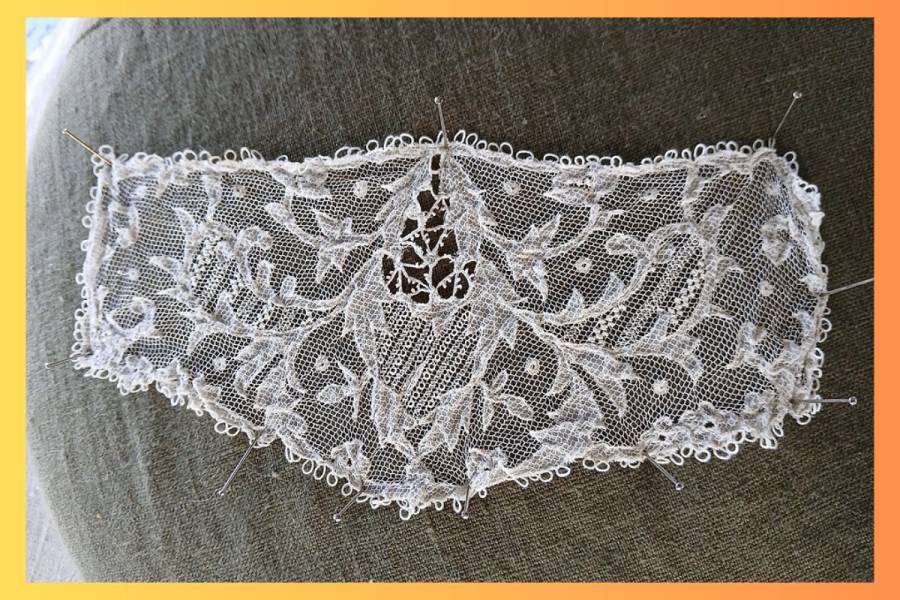
The gown was made using Carrickmacross lace, a technique associated with County Monaghan since the 1820s. Rather than simply adding lace panels to an existing dress, Stewart designed an elaborate garment around the makers' specialist skills. The project was coordinated by Irish designer and educator Natalie B. Coleman, who had introduced Stewart to the craft.
Stewart drew the motifs himself, taking inspiration from Ireland's natural landscape. Brambles, blackberries, thorns and dragonflies run through the fabric, while a panel across the chest includes shamrocks and a four-leaf clover. The artisans translated the drawings into lace through intricate hand-stitching and cutwork, with lace appliqué constructed directly over the garment's seams.
The finished gown required 4,300 hours of labour and featured a hemline measuring 13 metres around, excluding the train and an additional skirt insert. Much of the needlework took place in the lacemakers' homes, with individual sections eventually brought together. It was a particularly ambitious commission for an art form traditionally associated with smaller pieces, wedding veils and ceremonial clothing.


The Couture Gown Left Ireland in a Plastic Bag
The final hours were spent racing to complete the garment before its journey to London. Lacemaker Martha Hughes recalled working alongside Theresa Kelly from 9:30am until 5:30am the following morning, while other makers stayed until 3am. Hughes then ironed the finished dress on a table in her home.
Despite the months of work, its departure was surprisingly ordinary. Hughes recalled that the garment left with Coleman in 'a plain little plastic bag,' bound for London ahead of its Paris debut. The dress would soon become the closing look of Stewart's first haute couture collection.
In Paris, McMenamy, a runway veteran associated with designers including Chanel and Valentino, appeared barefoot in the lace creation. The gown formed the finale of Stewart's couture presentation on 6 July. Stewart said, 'Carrickmacross lace allows me to bring hand-worked craft from Ireland into dialogue with couture at the highest level.'
Irish Lacemakers See Their Work on Display
The dress is now part of an exhibition titled Standing Ground: Ireland-France, Savoir-Faire, Innovation and the Future of Crafts. It opened on Wednesday, 11 November and runs until 10 January 2027, with free admission. A second Standing Ground gown, featuring a corseted bustier that required more than 500 hours of embroidery by Paris atelier Maison Vermont, is displayed alongside it.
✨ Opening today! ✨Discover Standing Ground: Ireland-France, Savoir-Faire, Innovation and the Future of Crafts at the National Museum of Ireland, Collins Barracks. 📍 Collins Barracks 🎟️ Free admission 📅 Until 10 Jan 2027 www.museum.ie/en-IE/Museum...#IrishCraft #FrenchCraft #SavoirFaire #Lace
— National Museum of Ireland (@nmireland.bsky.social) November 12, 2026 at 12:33 AM
[image or embed]
The occasion also brought the makers face to face with the finished garment. Theresa Kelly said, 'I never expected to see my work in the National Museum.' Sarah Hughes, the youngest contributor, identified the four-leaf clover she stitched into the chest panel while studying for her degree, saying, 'I was the person who stitched that.'
Funding from Design & Crafts Council Ireland and the Heritage Council helped make the lace commission possible. DCCI chief executive Mary Blanchfield said ensuring the makers were properly paid had been a priority for Stewart. For the lacemakers, the museum exhibition puts both their names and their handiwork in public view after the dress' Paris debut.