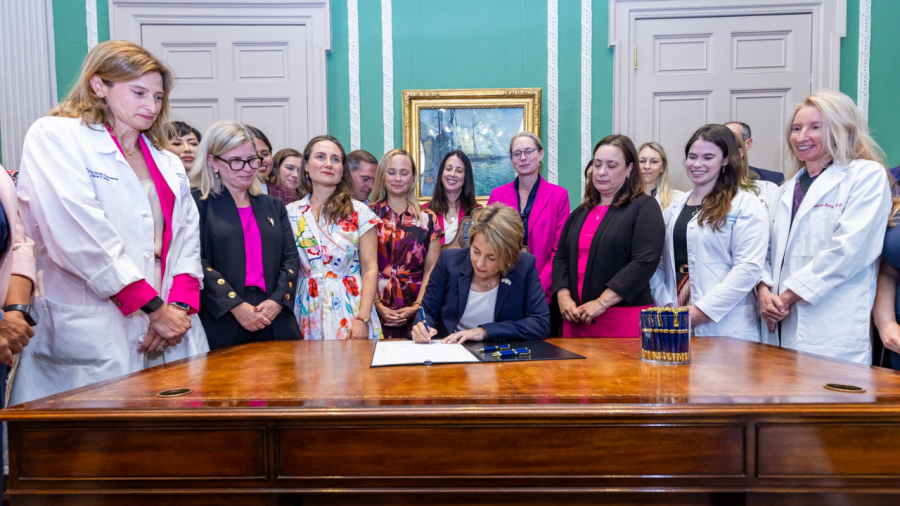
A major change to Massachusetts abortion law is now official after Gov. Maura Healey signed legislation allowing abortions later in pregnancy to be determined by a physician's professional medical judgment.
The move removes the state's previous 24-week framework and puts doctors and patients at the centre of decisions involving serious pregnancy complications and complex medical circumstances.
The law, known as the Prioritising Patient Access to Care Act, is intended to prevent patients from being forced to leave Massachusetts when their pregnancies become medically complicated. It also makes Massachusetts one of 10 states without a statutory gestational limit on abortion, according to the figures cited in the source material.
Healey Signs the New Abortion Law
Healey signed H.5595 at the Massachusetts State House in Boston, describing the legislation as a way to ensure women and families can receive care from doctors they know and trust. She argued that patients facing devastating news during wanted pregnancies should not have to travel hundreds of miles while dealing with grief and medical uncertainty.
The governor also positioned the law as part of Massachusetts' wider effort to protect reproductive healthcare following the Supreme Court's 2022 decision overturning Roe v. Wade. She said Massachusetts would continue protecting abortion access regardless of efforts by President Donald Trump, Republicans in Congress or the Supreme Court to restrict it.
The 24-Week Framework Has Been Removed
Under the previous Massachusetts law, abortions at or after 24 weeks were subject to a specific set of statutory exceptions. Doctors had to determine whether a patient's circumstances fitted those requirements before providing later abortion care.
H.5595 replaces that framework with language allowing an abortion to be performed by a physician based on the physician's professional judgment and accepted standards of care. The legislation also changes medical review requirements so that a review process cannot override the judgment of the treating physician and patient or their healthcare proxy.
Doctors Now Have Greater Medical Discretion
The phrase at the centre of the new law is professional medical judgment, particularly in cases where pregnancy becomes unexpectedly complicated. Supporters say the change recognises that medical situations can be unpredictable and cannot always be neatly placed into a list of legal exceptions.
The law is aimed at patients facing serious pregnancy complications, devastating fetal diagnoses and other complex circumstances. Supporters argue that doctors need enough discretion to provide timely care without worrying that a legal technicality could prevent them from treating a patient appropriately.
One Family's 33-Week Experience
Kate Dineen has become one of the most personal examples used by supporters of the legislation. In 2021, she was 33 weeks pregnant when she learned that her baby had suffered a stroke in the womb, but the circumstances did not qualify for an exception under Massachusetts' previous rules.
Dineen and her husband, Alex Lawton, travelled to Washington, D.C., to receive care. Lawton described the experience as feeling like they were fugitives leaving their home state, while Dineen said their doctor's hands had been tied by the law despite the devastating diagnosis.
Supporters Say Patients Can Stay Home
Supporters argue that cases such as Dineen's show why doctors should have greater authority when pregnancies become medically complicated. They say the previous restrictions could force patients to leave Massachusetts, separating them from their usual doctors, families and support networks during deeply distressing situations.
The legislation also removes certain reporting and facility requirements that supporters say created unnecessary barriers. Reproductive health organisations and medical groups welcomed the change, arguing that patients should be able to receive evidence-based care within their own communities.
Opponents Warn of Reduced Oversight
The legislation has also drawn strong criticism from opponents, who argue that removing gestational restrictions weakens protections for unborn children and reduces oversight of later-pregnancy abortions. The Massachusetts Family Institute said removing Department of Public Health oversight over certain policies and protocols would create an accountability problem.
No matter what Donald Trump does, we will protect your reproductive freedom. pic.twitter.com/9fKXaaPEde
— Governor Maura Healey (@MassGovernor) August 10, 2026
The political consequences are also likely to continue as Healey campaigns for re-election in November. The bill passed the Massachusetts House by 119 votes to 33, with Republicans who voted opposing it, before reaching the governor's desk. Healey's signature now places professional medical judgment firmly at the centre of Massachusetts' approach to abortion later in pregnancy.