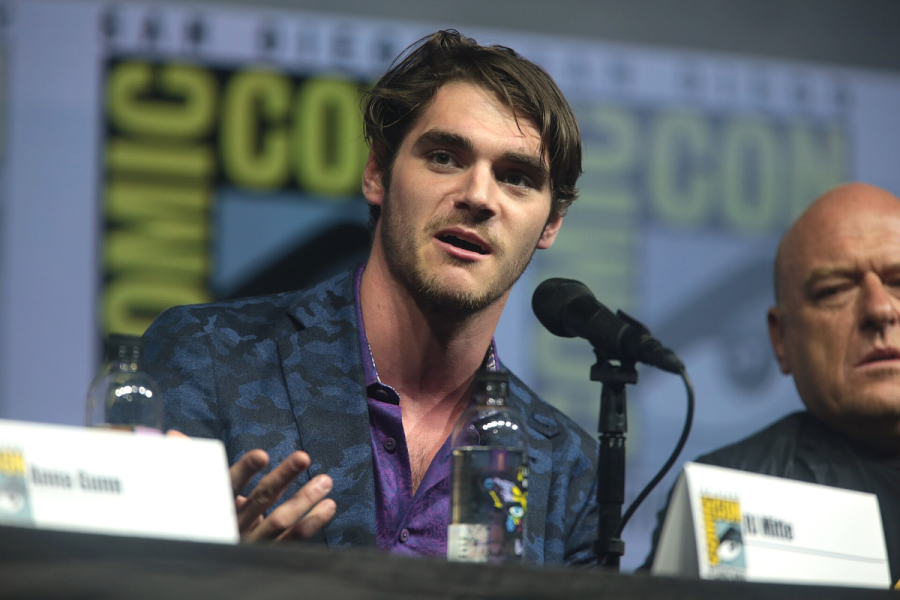
Hollywood's casting practices continue to prompt debate about diversity and representation, especially when selecting actors for complex roles. Private messages from late Breaking Bad star RJ Mitte express his frustration with limited opportunities available to him and raise questions about why Hollywood frequently overlooks underrepresented groups.
Mitte, who has cerebral palsy, reported receiving superficial scripts and being rejected for roles not focused on disability. His messages challenge an industry that often treats disability as a defining characteristic rather than one aspect of a performer's identity.
'Why Can't the Character Be Disabled?'
Mitte portrayed Walter White Jr., the son of Bryan Cranston's character, in AMC's Breaking Bad from 2008 to 2013. Although the role brought him recognition, his private messages – obtained by the Daily Mail, TMZ reported – reveal persistent barriers in pursuing other opportunities.
In a message from April 2017, Mitte described the response he sometimes received during casting: 'When I go for a part, they sometimes tell me that it's not a character with a disability, and I'm like why can't the character be disabled?' He added, 'They get real uncomfortable when I say that'.
In another message from the same month, Mitte wrote: 'I can do any role, but some of [the casting agents and directors] are a**holes who won't even look at me'.
Separately, in Talking to Strangers: On Living With Disability, he discusses how people stared at him because of his condition: 'You saw how everyone just looked at me in the break room. Like, like I'm the newest exhibit at the zoo, and that's what it's like for me. Every day'.
'Who wants to hire Walt Jr?'
Mitte's frustration extended beyond casting. In April 2022, he described receiving scripts that offered little opportunity for character development.
'Looking for interesting stuff to do, getting a lot of scripts where I would be a prop and they don't want to give any depth, three lines if that. I'm writing my own s**t now,' he wrote.
By August that year, he expressed frustration at receiving animation work while struggling to secure on-screen roles. 'Just doing animation, no one wants me on screen ... it's annoying as f**k,' he wrote.
His messages also highlighted the assumptions disabled performers encounter beyond casting. During the Covid-19 pandemic in March 2021, Mitte wrote that he had to 'convince people that I'm not going to die of COVID'.
This also created practical challenges. Mitte sought enough work in the United States to maintain his health insurance, noting earlier that international projects could complicate his coverage.
Collectively, these messages reveal barriers that extend beyond an actor's ability. Disabled performers often struggle to access auditions, secure substantial roles, and compete equally with non-disabled actors.

Disability Representation Gap
Broader data indicate that Hollywood continues to provide limited opportunities for disabled performers. UCLA's 2026 Hollywood Diversity Report found that actors with known disabilities accounted for 8.7% of main-cast roles and 9.3% of lead roles in top theatrical films in 2025. Since 26% of US adults have a disability, a significant gap remains between on-screen representation and the general population.
However, the industry has also taken steps to improve disability representation. For example, the Ruderman Family Foundation's Seal of Authentic Representation recognises productions that cast actors with disabilities in speaking roles, though concerns remain about their access to substantial parts.
In 2026, its Seal of Authentic Representation honoured five titles: Code of Silence, Pulse, Good Bad Things, We Might Regret This, and A Different Man. To qualify, performers with disabilities must have at least five lines in a speaking role.
Casting Controversies in Hollywood
Mitte's concerns reflect ongoing disputes over productions casting non-disabled actors in roles involving disability or physical differences. In 2023, actors with dwarfism criticised Hugh Grant's casting as an Oompa Loompa in Wonka. They argued that digital effects used to simulate dwarfism excluded performers from their community, who already face limited opportunities.
Actors with dwarfism are calling out Hugh Grant's Oompa-Loompa casting in #Wonka. https://t.co/KPz6ruCODB pic.twitter.com/7FaYIysYB1
— ComicBook.com (@ComicBook) August 5, 2023
Disney's live-action Snow White also drew backlash for its casting decisions and portrayal of the seven dwarfs. Similarly, Sia's film Music was criticised for casting Maddie Ziegler, a non-autistic actor, as a non-speaking autistic teenager. Critics questioned this decision and further raised concerns about the film's depiction of autism, particularly in scenes involving physical restraint.
We caught up with the Kate Hudson and Maddie Zeigler, the leading ladies of Sia's new film to hear all about how they made, 'Music'! #9Today pic.twitter.com/DLsAEhY3XS
— The Today Show (@TheTodayShow) January 18, 2021
A petition urging the Hollywood Foreign Press Association to rescind the film's Golden Globe nominations received over 45,000 signatures. Sia later apologised to the autistic community and committed to removing the restraint scenes from future versions.
These debates reflect broader concerns about 'cripping up', a term for non-disabled actors portraying disabled characters. In a 2021 ABC News analysis, journalist Gae Lee examined why casting disabled performers matters for authentic representation and better employment in such an underrepresented industry.
Calls for Authentic Casting
Mitte has also spoken publicly about how his disreability influenced his career. In a 2015 interview with The Badger Herald, he shared, 'I think everyone that has a disability has the opportunity to make an impact with what they can do and who they are. I wouldn't be able to do what I do today if it wasn't for my disability and what it instilled in me'.
His private messages highlight the contrast between his optimism and the limited opportunities he faced. Despite his prominent role in Breaking Bad, he kept seeking more complex roles beyond those defined by disability.
His messages raise an important question: Does Hollywood give actors with disabilities the same chances to play a wide range of characters, including those from underrepresented groups?