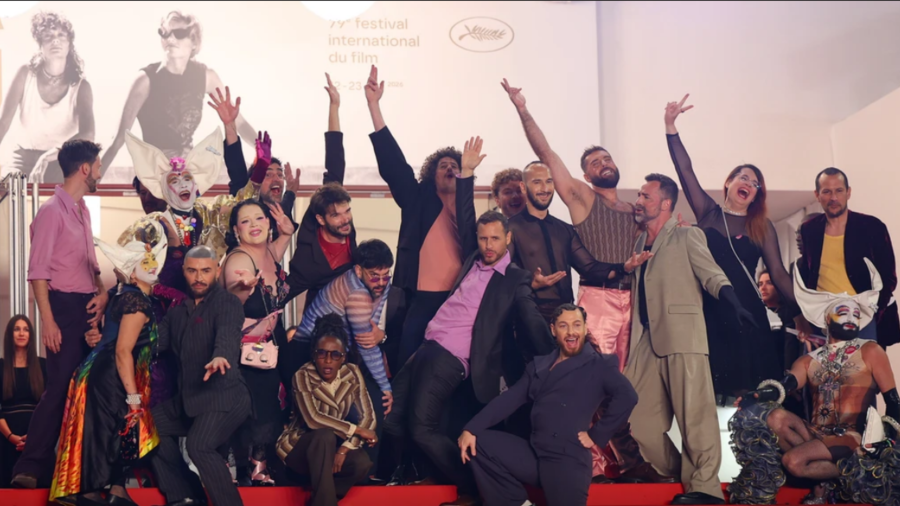
It's one of those Cannes moments that keep resurfacing online every year. Someone steps onto the iconic red carpet stairs, finds their pose, maybe even starts to settle into it — and then, almost instantly, a security guard appears to move them along. The moment ends just as quickly as it begins.
This week, those clips have been doing the rounds again. They feel slightly awkward to watch, a bit abrupt in places, and yet they're strangely compelling. Some see it as unnecessarily harsh; others shrug it off as how a tightly run film festival has to operate. Either way, it's sparked the familiar debate all over again.
And really, what's interesting isn't just the footage itself, but the way it highlights the growing tension between how Cannes works today and how people now experience events through social media.
Why It Looks Harsh — And Why It Isn't That Simple
At first glance, it's easy to interpret what's happening as someone being rushed or cut off mid-moment. But Cannes doesn't really function like a typical red carpet in the celebrity sense. It's part of a much larger machine, where screenings, arrivals, and press timings are all running on a strict schedule.
The stairs in particular are a pinch point. If someone pauses too long to pose, it creates a knock-on effect behind them — guests slow down, photographers adjust, and suddenly a tightly timed arrival sequence starts to slip. Security is there less as 'enforcers' and more as people trying to keep a constant flow moving.
It might not feel graceful in a short clip online, but in real time, it's more about preventing congestion than stopping anyone from having their moment.
When Two Versions of Cannes Collide
What's changed in recent years is less about the festival itself and more about who is walking through it.
Cannes used to be almost entirely centred around film — actors, directors, producers, critics. Now, it sits at the intersection of cinema, fashion, brand culture, and social media. That shift has quietly changed what people expect from the red carpet.
On one side, there's the traditional structure: keep moving, don't block the stairs, let the schedule run. On the other hand, there's a newer expectation shaped by Instagram and TikTok — where every step, turn, and pose is part of the content.
Neither approach is wrong, but they don't naturally align. One is built around timing and flow, the other around capture and visibility. That's where the friction comes from.
Why the Reactions Always Split
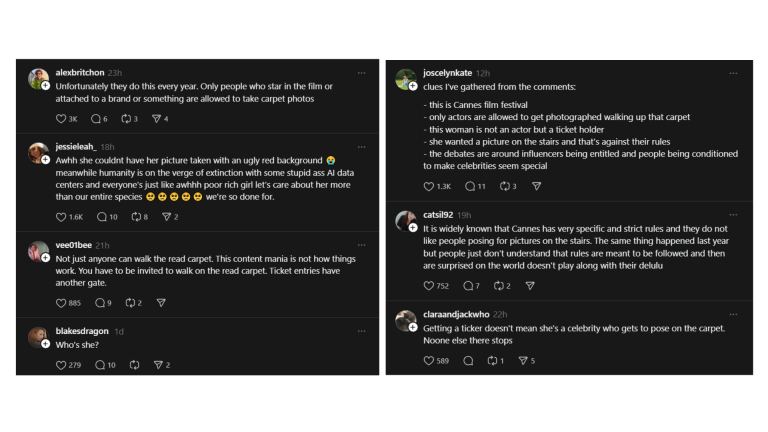
Online reactions to these clips tend to fall into two very familiar camps.
One group argues that Cannes is, at its core, a film festival. From that perspective, the red carpet is not a stage for extended posing unless you're part of the official programme. The expectation is simple: move through efficiently and keep the focus on the films themselves.
The other group sees things differently. If creators, influencers, and brand partners are invited into the space — often specifically because of their online reach — then it feels contradictory to restrict how they use it. In their view, the festival benefits from the attention these moments generate, so the rules can feel a little out of step with how modern visibility works.
And then there's the question that keeps quietly resurfacing in every comment section: would the reaction be the same if it were a major Hollywood star taking their time on those stairs?
The Real Story Behind the Viral Moment
Taken on its own, it's a small interaction — a few seconds of someone being guided forward during a photo moment. But it keeps going viral because it captures something larger than itself.
Cannes is currently balancing two identities that don't always sit comfortably together. It wants to remain a highly controlled, prestigious film institution, but it also exists in an era where global attention is driven by shareable, visual moments.
That's why these clips land the way they do. They're not just about one person being moved along — they're about the uneasy overlap between a festival built on tradition and a media landscape built on speed, visibility, and constant documentation.
And that tension isn't going away any time soon.