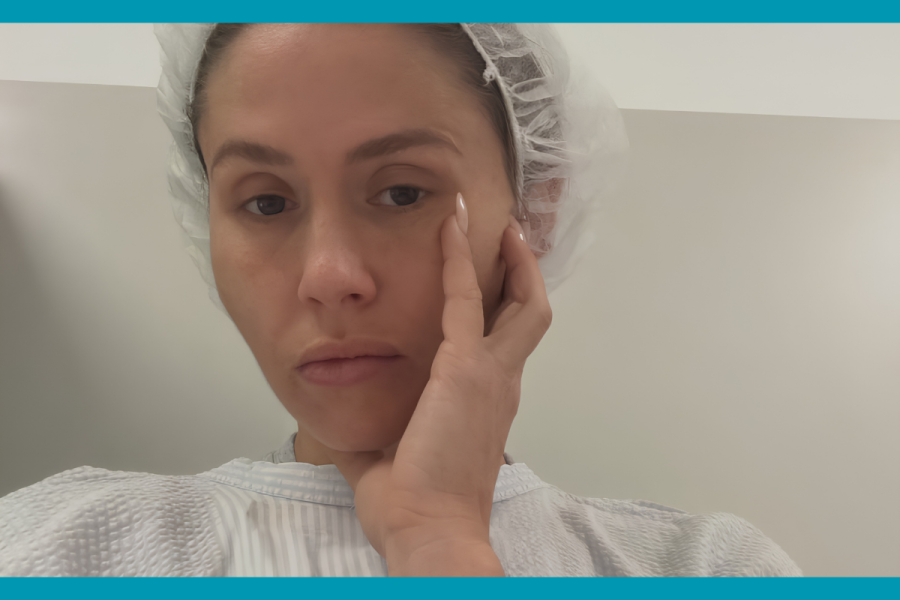
Ruby Tuesday Matthews woke up the morning after her facelift, and her own phone rejected her. Her jawline swelled overnight, and Face ID stopped granting her full access to her phone. Because nearly every app demanded a fresh face scan for two-factor authentication, she couldn't get back into her texts with a simple passcode.
Matthews, 33, travelled to Ilchi Plastic Surgery in Seoul for an endoscopic lift on Friday, 21 August. Within a day, her own phone had essentially declared her a stranger. Her digital life- banking, messages, boarding passes—sat behind a face her camera no longer recognised, a problem nobody warns patients about before they book flights for surgery abroad.
Why Facial Surgery Triggers Face ID Failures
Face ID doesn't read a photo. It maps a face's depth and geometry using infrared and thousands of invisible dots, checking micro-contours against a stored model every time the screen lights up.
Swelling that distorts those contours enough gets rejected outright, since the system is built to refuse a doubtful match rather than risk a false unlock. That's why a passcode alone didn't fix Matthews' problem.
Her phone unlocked fine, but individual apps still demanded a fresh biometric scan on login, and those stayed shut. 'Because it has two-factor authentication for like every single app, I can't log into my texts,' she explained, the exact issue that sent her to the Apple Store in bandages, hoping a manual reset would teach the system to accept her swollen face as valid.
Endoscopic lifts tighten deep facial tissue, not just skin, and that depth produces severe swelling. Fluid gathers around the cheeks, jaw and eye sockets as the body reacts to internal trauma, usually peaking between 48 and 72 hours after surgery rather than on day one. That timeline matches when Matthews said her face ballooned further than expected, well past the point her phone would recognise her.
Passing Passport Control After Surgery
A locked phone is manageable. A locked passport isn't. Travellers flying home days after major facial surgery have been stopped at immigration desks where officials refused to match swollen, bandaged faces to passport photos, in some cases blocking boarding altogether.
A Face ID failure is an early sign of that same mismatch: a face that has genuinely changed shape overnight, and border staff working from a static photo hit the identical wall a phone camera does.
Patients heading abroad for cosmetic work would be wise to set a passcode as their default unlock method before the flight out, add an alternate Face ID scan in settings while there's still time, and carry a printed boarding pass and hotel confirmation rather than depending on a phone that might not cooperate.
Matthews kept filming through the harder days regardless, and her account works as a useful case study precisely because the friction wasn't medical, but digital.
Biometric security keeps tightening its grip on daily life — airports, banks, and phones — and the gap between how fast a face can change and how slowly those systems catch up shows no sign of closing.