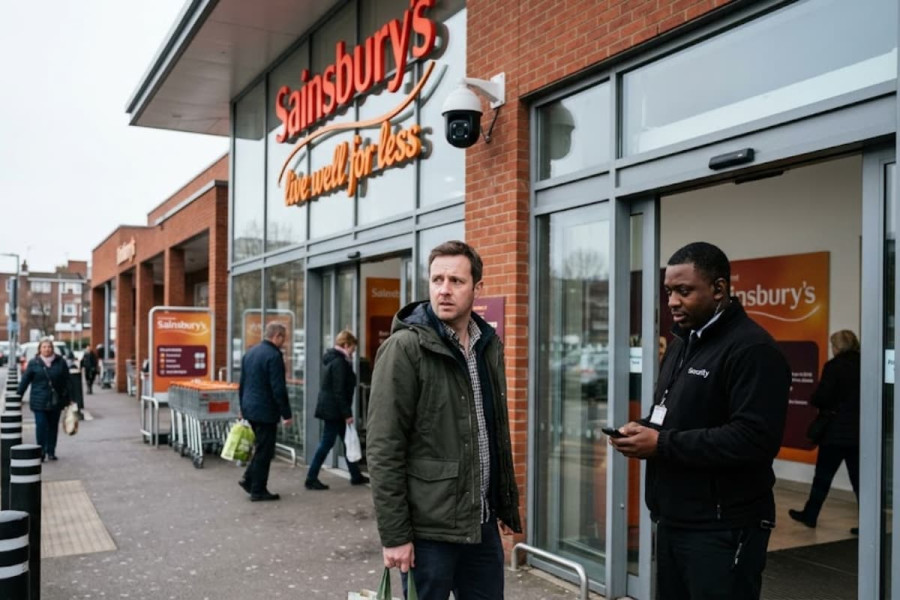
Sainsbury's has suspended its live artificial intelligence facial recognition technology at one of its London stores after a customer was wrongly identified as a suspected shoplifter.
The incident has renewed questions about using facial recognition in retail, particularly when automated systems identify people who may have previously been linked to criminal activity.
The customer, Matt Arnold, said he was left deeply unsettled after staff acted on an automated alert and asked him to leave the Sainsbury's store in East Dulwich.
Customer Describes 'Terrifying Glimpse of the Future'
Arnold said the experience was particularly disturbing because he had done nothing wrong. He was reportedly confronted after the store's facial recognition system generated an alert suggesting that he matched the details of an individual associated with previous offending.
Rather than being treated as a routine technology error, the alert led the store staff to act, ultimately resulting in Arnold being asked to leave.
He described the experience as a 'terrifying glimpse of the future', highlighting concerns about what can happen when artificial intelligence is used to make or influence decisions about members of the public.
The incident also raises a wider question for retailers: how much responsibility should be placed on automated technology when a false identification can have immediate consequences for an innocent customer?
Sainsbury's Suspends Live Facial Recognition
Following the incident, Sainsbury's suspended its live facial recognition technology at the East Dulwich branch.
The supermarket and Facewatch, the technology company providing the facial recognition system, have both maintained that a failure of the underlying AI technology did not cause the incident. Instead, the companies said the problem stemmed from human error in the way the alert was handled.
That distinction is significant. While facial recognition technology may generate an alert based on a potential match, people are ultimately responsible for deciding how that information is interpreted and what action should follow.
In Arnold's case, however, the consequences demonstrate how quickly an automated alert can affect someone before the information behind it has been properly checked.
How Accurate Is the Facial Recognition System?
Facewatch has previously claimed an accuracy rate of 99.98 per cent for its technology.
At first glance, such a figure may appear extremely high. But Arnold pointed out that even a very small error rate can potentially affect a substantial number of people when a system is used across busy retail environments.
This is one of the central concerns surrounding facial recognition technology. A system can have a very high reported accuracy rate while still producing incorrect matches.
For an individual wrongly identified in a shop, the consequences can be embarrassing and distressing, particularly if employees respond to the alert as though it were confirmation of wrongdoing.
The distinction between a potential match and proof of identity therefore becomes crucial.
It Is Not the First Sainsbury's Facial Recognition Incident
The East Dulwich case is also not an isolated incident.
In January, another customer at a London Sainsbury's branch was reportedly asked to leave after being mistakenly confused with an offender.
The recurrence of false identification incidents has added to concerns over how facial recognition systems are being deployed in shops and how staff are trained to respond when an alert is generated.
Retailers increasingly see technology as a way to tackle theft and improve security. However, the use of biometric technology also brings a responsibility to ensure that innocent shoppers are not unfairly treated as suspects.
The Growing Debate Over AI in Retail
Facial recognition is becoming an increasingly controversial part of the debate surrounding artificial intelligence in public and commercial spaces.
For retailers, the potential benefits are clear. Technology that can identify individuals linked to previous offences could help security teams respond more quickly to suspected theft and protect stores from repeat offenders.
But the technology also presents challenges. Unlike a traditional security camera, facial recognition processes biometric information and can directly associate an individual with an identity.
That makes mistakes particularly sensitive.
A wrongly identified customer is not simply dealing with a faulty camera. They may be confronted by staff, questioned or asked to leave based on a system-generated alert.
What Happens Next for Sainsbury's?
Sainsbury's decision to suspend live facial recognition at the East Dulwich store allows the supermarket to review how the technology is being used and how employees respond to alerts.
The incident also underlines the importance of human oversight. Even where facial recognition software has a very high claimed accuracy rate, an automated match should not automatically be treated as proof that someone has committed an offence.
For customers, the controversy is likely to fuel continuing questions about privacy, accuracy and accountability as artificial intelligence becomes more common in everyday shopping.
The Sainsbury's incident reminds us that behind every automated alert is a real person who can be affected by the decision that follows. For technology designed to improve security, protecting innocent shoppers from false accusations is just as important as identifying genuine offenders.