Fendi found itself at the centre of Milan Fashion Week's fur debate just days after sending fur-trimmed looks down its spring/summer 2027 runway.
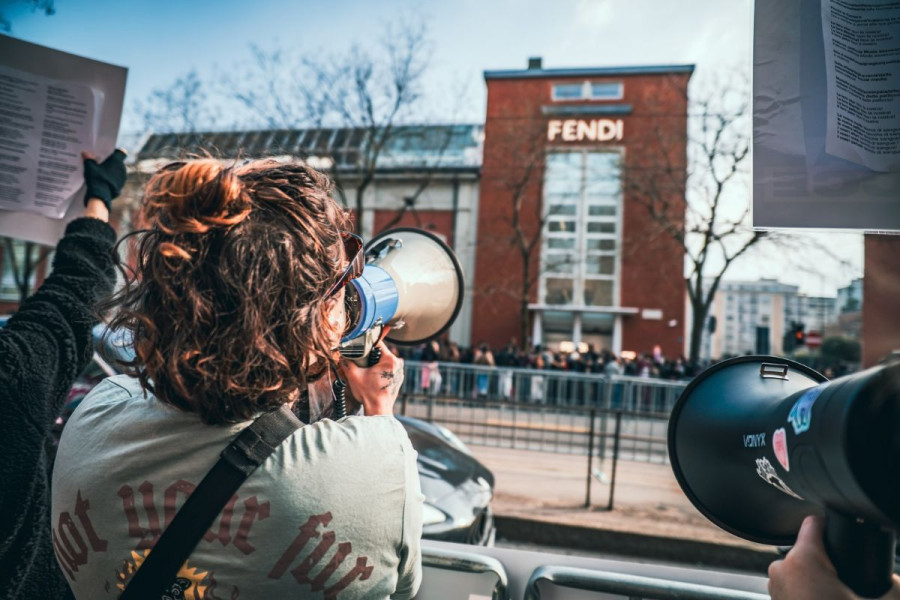
Hundreds of anti-fur campaigners marched through Milan on 26 September, calling for a ban on fur at Milan Fashion Week. Protesters stopped outside Fendi as part of the wider demonstration, where police officers stood guard as campaigners chanted and carried anti-fur signs and banners.
The demonstration came three days after Fendi presented Maria Grazia Chiuri's latest collection, which featured fur alongside lingerie, sheer fabrics and references to 1970s Italian glamour.
Fendi was among the fashion houses targeted during a broader campaign against fur at Milan Fashion Week, as activists pushed for mandatory restrictions rather than the voluntary guidance introduced by the Italian fashion industry association that organises the event.
Protesters Take Anti-Fur Campaign Through Milan
The 26 September demonstration brought hundreds of protesters into Milan's fashion district during one of the industry's biggest weeks. Placards carried messages including 'Fashion Victims' and 'Their Lives Are Worth More Than Your Outfit', while campaigners called for Milan Fashion Week to prohibit fur.
Protesters also unfurled a large banner reading 'Milan Fashion Week, Ban Fur Now' before marching through the city. The demonstration stopped outside several fashion businesses, including Fendi, where police officers stood guard as protesters gathered with banners and signs and chanted slogans.
Campaigners also demonstrated outside Philipp Plein. Footage showed some protesters confronting staff there before being pushed back, while another part of the demonstration involved activists sitting in the road.
The Coalition to Abolish the Fur Trade (CAFT) organised the march as part of an international week of action running from 22 to 28 September. CAFT said the campaign was intended to bring pressure directly to fashion businesses and events that the group considers responsible for keeping the fur industry alive.
Fendi Had Just Put Fur Back on the Milan Runway
Fendi's inclusion among the targeted stops came shortly after its spring/summer 2027 presentation on 23 September. Chiuri's collection mixed lingerie-inspired pieces and sheer fabrics with heavier materials, including fur.
Vogue's runway review described dresses fringed with beads and fur, lace-edged silk shorts worn beneath bralettes and fur, a jacket made from roughly cut pelts and an Afghan-style coat-dress that appeared to incorporate brown astrakhan. Other coverage highlighted fur stoles and colourful fur alongside lace, silk and sheer fabrics.
The collection drew inspiration from late Italian entertainer Raffaella Carrà, whom Chiuri described as an 'incredible feminist', and explored the relationship between clothing and the body. Fur has also appeared repeatedly in Chiuri's recent work for the fashion house.
Her autumn/winter 2026 debut at Fendi placed emphasis on fur, with Vogue describing fur trims, collars and fringes among elements of the collection. For Resort 2027, Chiuri again incorporated the material and explicitly connected it to Fendi's history.
'We should not forget that the company was born from fur, and fur itself already carries an idea of softness, an idea of sensuality,' Chiuri said.


Milan Fashion Week Asked Brands Not To Use Fur
The protest highlighted the continuing dispute over Milan Fashion Week's approach to fur. In May, Camera Nazionale della Moda Italiana, the Italian fashion industry association that organises Milan Fashion Week, published voluntary guidelines concerning the use of fur beginning with the September 2026 edition.
The guidelines invite participating brands not to show clothing, accessories or other items made using animal fur. The organisation also said it would not promote fur through communications content it produces for Milan Fashion Week.
The guidance, however, is voluntary rather than a mandatory prohibition on participating designers using fur. AFP reported that major Italian fashion houses including Armani, Prada and Dolce & Gabbana no longer use fur, while identifying Fendi as a notable exception.
New York and London Have Gone Further
Campaigners have also pointed to fur policies adopted elsewhere on the international fashion calendar. The Council of Fashion Designers of America's fur-free policy took effect for the September 2026 season and applies to collections appearing on the official New York Fashion Week schedule.
Under the policy, animal fur is prohibited from those collections, with an exemption for fur obtained by Indigenous communities through traditional subsistence hunting practices. The British Fashion Council announced in 2023 that fur-free requirements would be incorporated into the London Fashion Week application process from February 2024.
Milan's approach therefore differs from those policies because its guidance asks participating designers not to use fur rather than imposing a mandatory fur-free requirement. Campaigners are seeking to turn that voluntary position into a formal restriction.
Fur Remains Part of Fendi's Identity
Founded in Rome in 1925, Fendi developed a reputation for leather goods and fur, with the latter becoming one of its established house codes. Chiuri has repeatedly incorporated fur since returning to the fashion house and has explicitly connected the material with Fendi's heritage.
Her Resort 2027 comments acknowledged the company's origins in fur, while both her autumn/winter 2026 and spring/summer 2027 collections incorporated the material. The approach comes against a changing industry backdrop, with a number of fashion houses and industry organisations moving away from animal fur amid animal-welfare concerns, changing consumer attitudes and the development of alternative materials.
The CFDA has said its move away from animal fur could encourage designers to explore newer materials and has provided educational resources as part of New York Fashion Week's transition. For Milan, the dispute centres on whether its voluntary guidance should eventually become a mandatory fur-free requirement.