Halloween costumes rarely come with an art-history lesson, but Louis Vuitton's Spring/Summer 2008 collection makes a pretty convincing case for one. On 6 October 2007, creative director Marc Jacobs sent models down the runway in nurse-inspired looks drawn from American artist Richard Prince's provocative paintings, turning a familiar uniform into something glamorous, theatrical and slightly unsettling.
Nearly 19 years later, the collection remains an intriguing source of costume inspiration. With crisp white outfits, black lace face coverings and bold red beauty details, the looks offer an alternative to dressing as the latest viral celebrity or fictional character. More importantly, they have a backstory that goes beyond a well-styled outfit.
Richard Prince Made Nurses a Work of Art
Before the nurse uniform became a luxury-fashion statement, it was part of Prince's artistic universe. The American artist is known for appropriating existing images and recontextualising them, challenging ideas about originality, authorship and popular culture.
His Nurse series, developed during the 2000s, drew inspiration from vintage pulp-fiction book covers featuring nurses. Works including Nurse Kathy (2006–08), Nurse in Charge (2006–07) and Surf Safari Nurse (2007–08) transformed familiar commercial illustrations into striking, sometimes unsettling paintings.
These were not the reassuring portraits typically associated with healthcare campaigns. Prince's nurses appeared mysterious and cinematic, with obscured faces and a glamour that felt closer to a vintage thriller than a hospital drama. It raises an important question in contemporary art: can an image take on new meaning outside its original context?
When Marc Jacobs Brought Art To Louis Vuitton
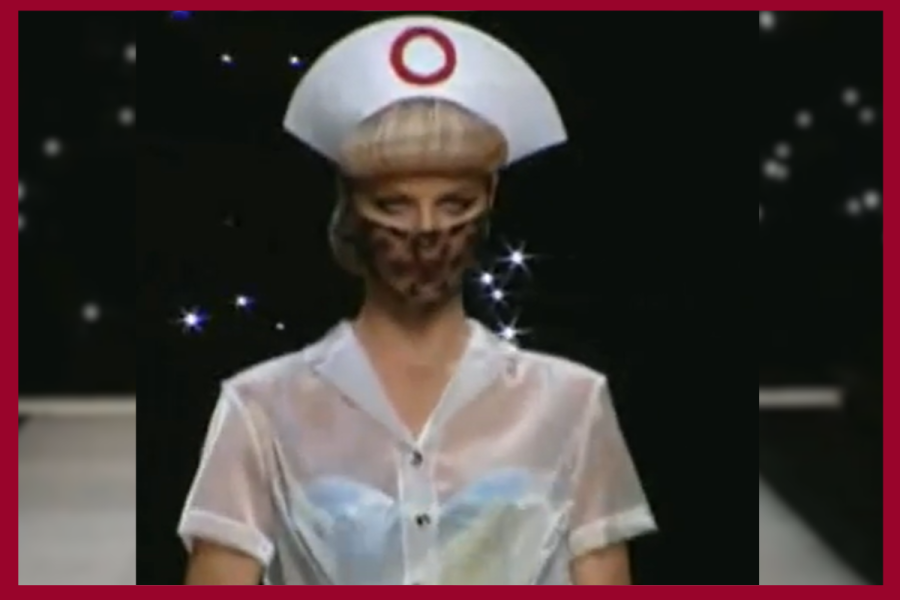
At Louis Vuitton's Spring/Summer 2008 show in Paris on 6 October 2007, Marc Jacobs brought Prince's art to the runway. Naomi Campbell, Eva Herzigova and Nadja Auermann modelled nurse-inspired looks featuring white uniforms, transparent coats, black lace masks, red lips and bags printed with Prince's imagery.

The styling played with contrasts. The white uniform suggested clinical precision, but the lace masks and dramatic beauty details gave the outfits a mysterious edge. The result was less a literal medical uniform than a character from Prince's painted world brought to life.
The accessories were equally important. By incorporating the artist's imagery into Louis Vuitton bags, Jacobs extended the collaboration beyond the clothes, turning familiar luxury accessories into canvases for contemporary art.
It was also part of Jacobs' wider strategy at the French fashion house. During his tenure as creative director, he collaborated with artists including Takashi Murakami and Stephen Sprouse, bringing bold graphics and contemporary visual culture into Louis Vuitton's signature accessories.
These partnerships helped make designer handbags cultural talking points in their own right. Prince's contribution added a more provocative dimension, questioning where art ends and commercial fashion begins.

Why the 2007 Collection Still Deserves Attention
Fashion has always had a complicated relationship with the past. Trends return, archival runway photographs circulate online, and looks once reserved for fashion insiders become references for a new generation.
The Louis Vuitton nurse collection offers more than a nostalgia trip. Its journey from pulp-fiction imagery to paintings, runway clothing and modern costume inspiration illustrates how visual references evolve as they move between different mediums.
An image that once sold a paperback becomes a work of art. That artwork inspires a luxury collection. Years later, the resulting outfits become a source of inspiration for people who may never have seen the original show.
Each version carries something from the one before it, while acquiring a new meaning along the way. That process sits at the heart of Prince's artistic practice and makes the collaboration particularly interesting beyond its clothes.
Turning the Runway Look Into a Halloween Costume
For anyone looking to bring a little fashion history into Halloween, the nurse-inspired ensembles offer a relatively straightforward starting point. A white dress or belted coat establishes the silhouette, while a nurse-inspired cap and black lace accessory reference the original styling. A bold red lip adds contrast, and a structured handbag completes the outfit without requiring an expensive designer purchase.
The trick is to focus on the visual language rather than recreate every detail of the runway. Clean white clothing against black lace, paired with polished beauty styling, captures the collection's theatrical quality without turning the costume into a generic fancy-dress uniform.
Nearly two decades after its debut, Jacobs' collaboration with Prince shows how a runway moment can outlast its season. The collection brought contemporary art into luxury fashion, challenged familiar visual conventions and created looks that remain instantly distinctive.
And if the result also happens to make an excellent Halloween costume, consider that a bonus. After all, why dress as just another character when you can arrive with an entire art-history reference?