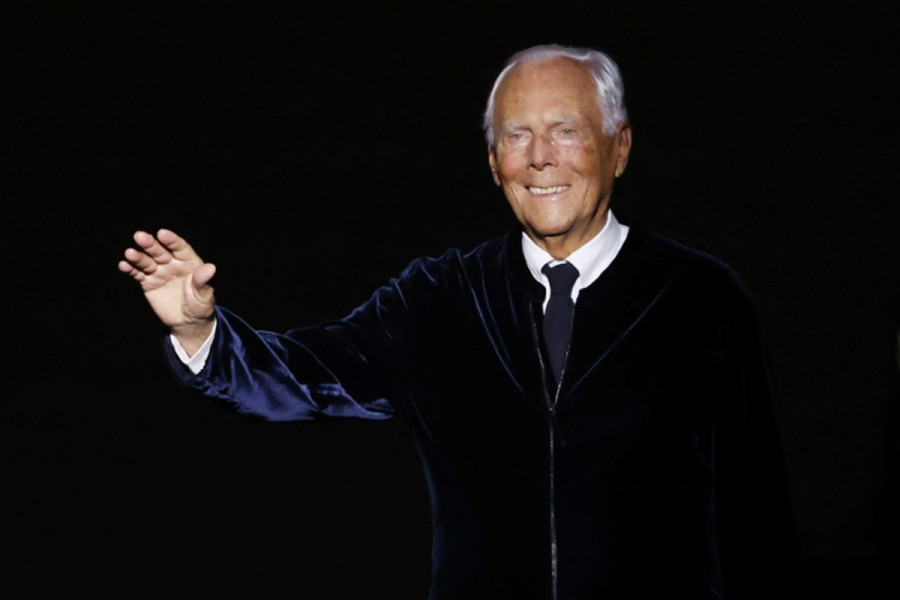
Giorgio Armani's carefully planned succession is moving closer to its first major test, with the fashion house preparing to explore a possible sale of a 15 per cent stake to investors including three companies named by its late founder as preferred buyers: L'Oréal, LVMH and EssilorLuxottica.
Armani died aged 91 on 4 September 2025, after building one of fashion's most recognisable independent luxury businesses. His will instructed his heirs to sell an initial 15 per cent stake within 12 to 18 months of his death, giving priority to LVMH, L'Oréal and EssilorLuxottica while also leaving open the possibility of another buyer of comparable standing.
The deadline is now approaching. Armani Group chief executive Giuseppe Marsocci said the company is open to having more than one investor take part in the transaction, although no final decision has been made.
'It is not written in stone that it has to be one investor,' Marsocci told reporters in Milan. Any agreement, he said, would depend on reaching a deal on price and other terms.


Why L'Oréal, LVMH And EssilorLuxottica?
Armani's choice of preferred buyers reflects their positions within the global luxury industry, as well as the longstanding commercial relationships that L'Oréal and EssilorLuxottica have with the fashion house.
L'Oréal has perhaps the clearest direct connection to Armani. The French beauty giant has held the licence for Armani's beauty business since 1988, covering fragrances, make-up and skincare. The partnership was extended in 2018 through to 2050, making L'Oréal a long-standing commercial partner of the Italian fashion house.
L'Oréal has also openly acknowledged its interest. In December 2025, chief financial officer Christophe Babule said L'Oréal would 'definitely' look at the possibility of investing in Armani, according to Reuters.
EssilorLuxottica, meanwhile, is Armani's established eyewear partner. The relationship dates back to 1988, when Armani and Luxottica first began their collaboration. After the original agreement ended in 2003, Luxottica entered a new 10-year licensing agreement with Armani in 2013, which was renewed for 15 years from 1 January 2023.
LVMH's connection is different. It is a major global luxury group and was specifically named among the preferred buyers in Armani's will, although L'Oréal and EssilorLuxottica have more direct longstanding licensing relationships with the fashion house.
Reports earlier this year suggested the 15 per cent holding could be divided equally, with each of the three companies taking about 5 per cent. That remains a reported proposal rather than a confirmed agreement.
Life of the Brand Beyond Giorgio Armani
The 15 per cent transaction is only the first stage of the succession plan laid out in Armani's will. After the initial sale, the succession plan envisions a possible additional transfer of between 30 and 54.9 per cent to the same buyer within three to five years, alongside the possibility of a stock-market listing. The structure is set as a gradual transfer of ownership rather than an immediate sale of the entire company.
For now, the central question is how the proposed investment will ultimately be structured. The company is considering a potential investment involving groups including L'Oréal, LVMH and EssilorLuxottica, with the three potentially sharing the initial stake. But until price, terms and the final ownership structure are agreed, no transaction has been completed.
The developments come as Armani navigates its first full year without its founder. The company has also appointed Dario Vitale as creative director of Emporio Armani and Giorgio Armani Accessories, marking another significant step in shaping the group's future after the designer's death.
Armani's will has done more than identify potential buyers. It has set out a staged transition for a fashion company that remained under the close control of its founder for decades.