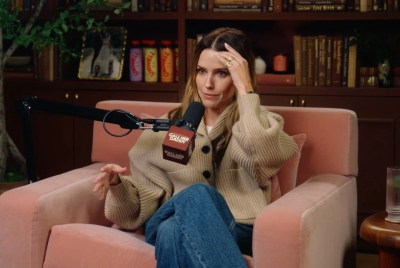
Jenny Mollen Biggs has unexpectedly become the centre of a heated online debate after a series of social media posts and a resurfaced essay reignited wider questions about parenting, boundaries, and how family life is shared in public. The actress and writer, known for roles in Angel, Girls and Crash, drew attention after posting photographs of herself in bed with her 12-year-old son alongside a caption that read: 'Your eldest son will be the most toxic guy you ever date.'
The reaction online was swift and sharply divided. Some saw it as an awkward but affectionate expression of motherhood, while others found it uncomfortable and inappropriate, particularly given the public setting and the wording. The discussion escalated further when an older Substack essay by Mollen resurfaced, bringing renewed scrutiny to how she describes parenting and emotional bonds with her children.

A Post That Divided Opinion
The Instagram images themselves showed a relaxed, intimate moment between mother and son, but it was the caption that ultimately triggered backlash. Thousands of comments followed, with users questioning whether the tone crossed a line between private affection and public oversharing.
Critics argued that framing a child-parent relationship in romantic or dating-style language felt misplaced, particularly when shared so openly online. Others pushed back against that interpretation, suggesting the response had been overstated and that the post simply reflected a mother's sense of humour and closeness with her child.
The debate widened when excerpts from Mollen's Substack essay began circulating again, drawing fresh attention to the way she writes about motherhood.

The Essay That Brought Renewed Scrutiny
In the essay, Mollen reflects on raising her two sons, Sid, 12, and Lazlo, 8, whom she shares with actor Jason Biggs. Written in a confessional, highly personal style, the piece explores motherhood, emotional attachment, and the gradual independence of children.
Some readers connected with its honesty, while others were unsettled by the way she used romantic or relationship-based metaphors to describe parenting. That contrast became the core of the backlash, with much of the conversation focusing less on intent and more on interpretation.
Mollen and Biggs confirmed earlier this year that they had separated after 18 years of marriage, though reports suggest they remain on good terms and continue co-parenting. That personal shift has also been referenced in discussions surrounding her recent writing, with some suggesting it adds emotional context to her reflections.
'Boy Mom' Culture and the Bigger Debate
Beyond Mollen herself, the reaction has fed into a broader online conversation about so-called 'boy mom' culture, a phrase often used to describe mothers who express particularly intense emotional bonds with their sons.
For some, it is simply a modern expression of close parenting. For others, it raises questions about emotional boundaries and how relationships are framed in public discourse. Social media users remain split, with interpretations ranging from supportive to strongly critical.
What stands out in much of the response is not just disagreement, but uncertainty over tone. Some readers view Mollen's writing as humour layered with exaggeration, while others read it as emotionally blurred storytelling that feels uncomfortable when taken at face value.
The Pressure of Public Visibility
As a public figure, Mollen's personal reflections inevitably sit within a wider culture of scrutiny. With a long career in entertainment and writing, and a high-profile marriage to American Pie actor Jason Biggs, her family life has often been visible to audiences.
That visibility has only intensified since their separation, with online audiences now analysing her posts through a more critical lens. The situation highlights how quickly personal expression can shift once it enters a public space, where tone, context and intent are easily lost.
What may begin as an informal or emotional reflection can rapidly become a viral talking point, shaped as much by audience reaction as by the original post itself.
A Conversation Still Unfolding
Mollen has not publicly addressed the backlash, and the caption in question has since been removed, though the images continue to circulate online.
As the discussion continues, it has moved beyond a single post or essay. Instead, it has opened up broader questions about how parents navigate identity online, where the boundaries of sharing should sit, and how easily personal expression can be reinterpreted once it becomes public.
In the end, the debate says as much about the internet's sensitivity to tone and context as it does about the original post itself, and that tension shows no sign of fading any time soon.