
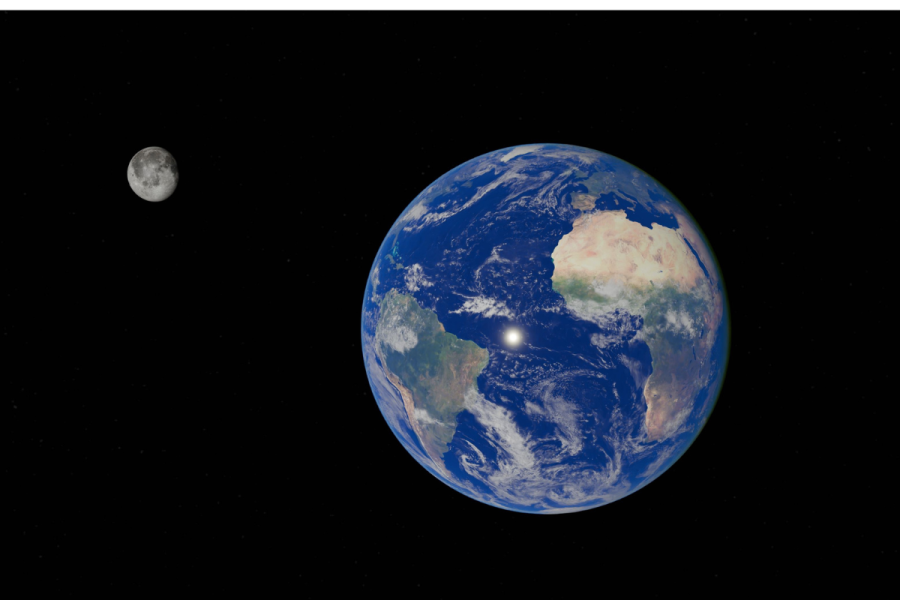
NASA has categorically confirmed that Earth will not lose gravity on Wednesday, 12 August 2026, after an AI fuelled hoax triggered alarming claims across Instagram, TikTok and X.
The false warning alleged that gravity would disappear worldwide for seven seconds because of colliding black holes, potentially sending people and objects into the air.
'The Earth will not lose gravity on August 12, 2026,' a NASA spokesperson said in a statement addressing the rumour.
The agency explained that Earth's gravitational force depends on the planet's mass, which is not about to disappear during today's solar eclipse or any other scheduled astronomical event.
Inside the Viral 'Project Anchor' Hoax
On August 12, 2026, the world will lose gravity for 7 seconds. NASA knows. They’re preparing but won’t tell us why. In November 2024, a secret NASA document titled “Project Anchor” leaked online. The project’s budget is $89 billion, & its goal is to survive a 7-second… pic.twitter.com/XS567dYvu8
— M.A. (@MaDJEric) August 9, 2026
The conspiracy centred on a supposed classified NASA operation called 'Project Anchor', allegedly created after officials discovered an approaching gravitational anomaly. Posts claimed the fictional programme had an $89 billion budget and was preparing governments for 40 million deaths, infrastructure destruction and an economic collapse lasting more than a decade. No authentic NASA document or public record supporting the programme has been produced.
One of the earliest widely shared versions appeared on Instagram on 31 December 2025, although the post claimed the secret document had leaked in November 2024. The account behind it published fabricated conspiracy content, while researchers examining the video identified signs associated with AI generated storytelling, including formulaic captions and unusual emoji use. Copies then spread across other platforms, with users adding increasingly dramatic details as 12 August approached.
@pr3sidnt_69 No Gravity For 7 Seconds 😳 #nasa #gravity
♬ original sound - PR3SIDNT
Some versions claimed the event would begin at precisely 14:33 UTC and cause unsecured people, animals, cars and even bodies of water to rise as high as 20 metres. The theory blamed intersecting gravitational waves produced by black holes, using scientific terms to make the warning appear credible. NASA said neither the proposed cause nor the predicted outcome reflects how gravity works.
Why Gravity Cannot Simply Switch Off
Earth's gravity exists because Earth has mass, including its core, mantle, crust, oceans and atmosphere. For its gravitational pull to disappear, the planet would need to lose that mass, not merely pass through an eclipse or encounter a gravitational wave. NASA said the combined Earth system is not undergoing any such change.
The Laser Interferometer Gravitational Wave Observatory describes gravitational waves as 'ripples in space-time caused by some of the most violent and energetic processes in the Universe'. Although events such as merging black holes can produce them, the distortions reaching Earth are so small that highly sensitive instruments are required to detect them. They do not cancel the planet's gravitational field or cause objects to float.
NASA also addressed attempts to connect the rumour with today's eclipse. 'A total solar eclipse has no unusual impact on Earth's gravity,' the agency said. The Sun and Moon affect predictable tidal forces, but an eclipse does not switch gravity off.
What Is Actually Happening Today
A real total solar eclipse is crossing Greenland, Iceland, northern Russia, the Atlantic Ocean, Spain and a small corner of Portugal on 12 August. Parts of the northern United States, Canada, Europe and northwestern Africa will experience a partial eclipse, according to NASA's official eclipse guidance. Totality will last less than two and a half minutes at every location along its path.
The Perseid meteor shower is also reaching its peak on 12 and 13 August, creating another genuine astronomical event around the date used by the hoax. Neither the eclipse nor the meteor shower poses a threat to Earth's gravity. NASA's confirmation means there is no scientific reason for people to shelter, secure themselves indoors or prepare for a seven second gravity blackout.