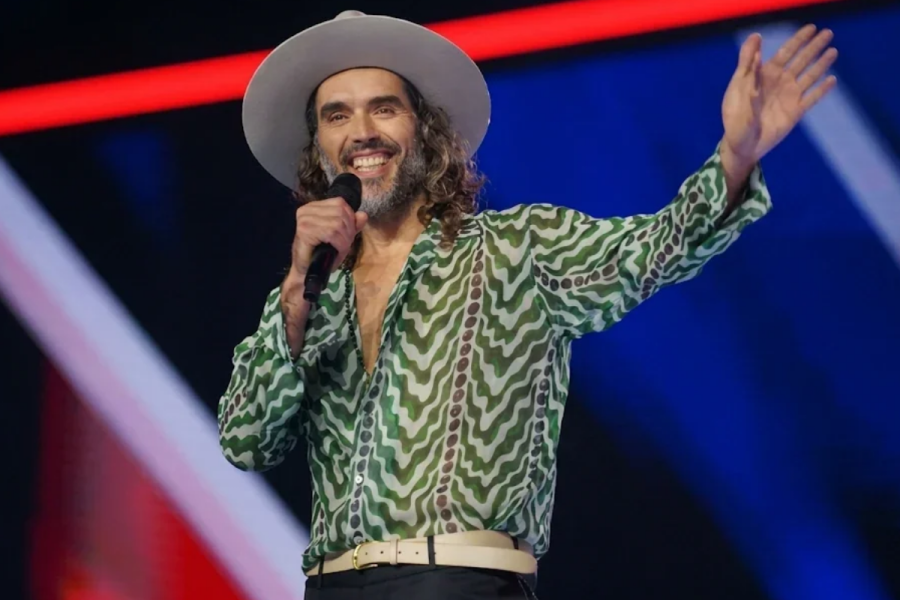
Russell Brand wrote that he 'would never have relented until I received my birthright orgasm' in a memoir published in 2007, 19 years before the passage was read to jurors at his rape trial. The extract became part of the prosecution's wider challenge to his testimony that consent was more important to him than sex.
Prosecutor Riel Karmy-Jones KC questioned Brand about My Booky Wook at Southwark Crown Court on 28 October 2026, then returned to its language in her closing speech two days later. His defence challenged the prosecution's reliance on the memoir, describing it as a 'funny book' containing jokes and calling its use a 'bid of desperation.'
What Brand Wrote About His Pursuit of Women
The passages included Brand's description of how his 'egotism and the single-mindedness' in pursuing 'potentially sexual conquests' could make him 'uneasy company.' Elsewhere, he described himself as a 'fervid, febrile mass of sexual energy' towards the end of sex, adding: 'I'll do anything. I'm demonically sexy.'
Another extract concerned his determination when pursuing 'a job or a woman,' placing both within an account of obtaining something he wanted. He wrote that he would 'determinedly, resolutely, remove anything that's in the way, until I possess the object of my desire.'
In his 2007 autobiography, My Booky Wook, Russell Brand wrote: “This is the exact moment when I decided to act gay to attract girls. It took 15 years to produce results.”
— Mukhtar (@I_amMukhtar) October 29, 2026
Yesterday he denied that he acted gay to attract girls. pic.twitter.com/g6aBoiLINm
Prosecutors questioned Brand about a memoir caption describing his decision to 'act gay to attract girls.' He denied doing so and said the caption was a joke.
Why Prosecutors Challenged Brand on Consent
Karmy-Jones quoted the passage about removing obstacles in her closing speech, arguing that Brand's published descriptions conflicted with his evidence about consent. A lack of consent, she told jurors, was 'just an obstacle he would have to remove, or perhaps ignore.'
She asked whether his testimony that consent was 'fundamental, more important than the sex itself' rang true against the evidence heard during the trial. She also cited a 2017 interview in which he described women as 'amusements' in a 'playground of orgasms,' arguing that he had treated women as 'a means to an end.'
The Rape Behind the 'Birthright Orgasm' Remark

The woman whose allegation Karmy-Jones addressed told jurors that she had willingly participated in a threesome with Brand backstage on the night of his 2009 Hammersmith Apollo performance. She visited his Hampstead home days later, where she said the initially-consensual sexual activity turned into rape when he forced her to have anal sex without consent and ignored her pleas to stop.
Karmy-Jones argued that the woman had been fair to Brand by distinguishing their consensual sexual activity from the subsequent rape she alleged. She said he cared about obtaining his 'birthright orgasm,' adding: 'She did say no, she did say stop, but he did not.'
Defence barrister Ian Winter KC called the prosecution's reliance on My Booky Wook a 'bid of desperation' during his closing speech on 2 November. He described it as a 'funny book' and used a childhood photograph caption to illustrate his argument that it contained jokes.
Discussing that caption rather than the 'birthright orgasm' passage, Winter questioned how writing published in 2007 could establish Brand's behaviour in 1999. The trial involved seven charges concerning six women, with alleged incidents spanning 1999 to 2009.
Brand's Evidence and the Jury's Verdicts
Brand denied all charges and told jurors he had been 'a very determined and focused man,' describing his behaviour towards women as 'persuasive, seductive, begging and flirting.' He acknowledged it had been wrong to let fame 'facilitate sexual access,' but maintained that consent was more important than sex.
On 5 November, jurors convicted Brand of raping the woman at his Hampstead home in 2009 and of three sexual assaults, while acquitting him of two other rape charges and one count of attempted indecent assault. The memoir formed part of the prosecution's challenge to his account, but the reported verdicts do not establish what weight jurors gave its passages.