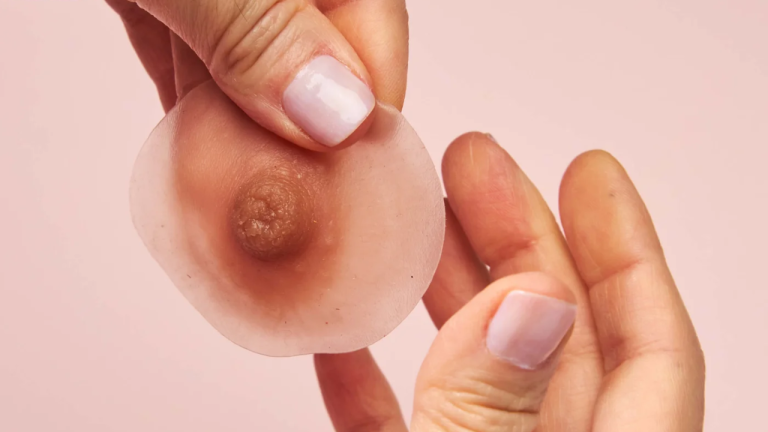
An unusual-looking medical device has caught attention online because it is not quite what it first appears to be. The removable silicone nipple prosthesis is designed for women who have lost the nipple and areola during a mastectomy, with custom-made versions created to closely match the natural side.
The device was highlighted in an X post showing an artificial breast nipple, prompting some social-media users to praise the technology while another commenter questioned whether an artificial nipple should be necessary after mastectomy. But beyond the online reactions, clinical research has found that these external prostheses can provide a realistic-looking nipple-areola appearance and may be used temporarily or as a longer-term option.
The Silicone Prosthesis Is Made To Look Natural
A nipple prosthesis is an external device made from medical-grade silicone that recreates the appearance of a nipple and areola. It is placed directly onto the skin using a medical adhesive, meaning there is no incision, anaesthetic or additional surgical recovery involved.
This is what an artificial breast nipple looks like. 😳
— Dr. Chibuike M. (@Dr_Chibuike_M) September 15, 2026
It may be used after breast surgery, such as a mastectomy, when the natural nipple has been removed. pic.twitter.com/7eVz7yBRaV
The exact appearance can vary depending on the product, but custom-made versions can be individually pigmented and sculpted to reflect a person's skin tone, anatomy and natural nipple. For someone who has had a unilateral mastectomy, the aim can be to make the prosthesis closely resemble the remaining natural nipple and areola.
Custom Versions Can Match the Other Side
RmonyCare says its custom-made prostheses are individually coloured and sculpted according to the user's skin tone, undertones and anatomical dimensions. The company also offers a pre-surgery moulding option intended to preserve the shape of a natural areola before surgery for later reproduction.
There are also ready-to-wear versions with pre-designed sizes and skin tones, giving women another option depending on their circumstances. RmonyCare says both approaches are intended for women who may not want nipple reconstruction surgery, are waiting before making a permanent decision, or simply prefer a non-surgical option.
A Study Found High Satisfaction Among Patients
A prospective study published in JPRAS Open examined nipple-areola complex prostheses among 20 women who had undergone unilateral mastectomy, breast reconstruction and removal of the nipple-areola complex. Researchers found that 95% were satisfied or very satisfied with the prosthesis' appearance and symmetry compared with their natural nipple on the opposite side.
The study also reported that all participants said they were more or much more satisfied with their body image when wearing the prosthesis. However, the research was small, involved only 20 participants and assessed a particular prosthesis, so its findings should not be treated as evidence that every product will produce the same results.


Some Women Used Them Every Day
The research found that 68.75% of participants used their prosthesis daily, while others wore it occasionally, including during sports or when wearing tighter clothing. Participants reported using the device for an average of 5.8 days per week, while the study recorded periods of several consecutive days without reapplying the adhesive.
The study also found that 90% of participants experienced no skin reaction, infection or erosion at the prosthesis site. Two women developed temporary redness and itching, and both had previously received radiotherapy, highlighting why individual medical advice remains important before using one.
The Device Can Be Temporary or Long Term
For some women, the prosthesis can provide a way to recreate nipple projection while they consider surgical reconstruction or tattooing. In the study, 35% planned to keep using the prosthesis as a definitive solution, while another 35% planned to have surgical nipple reconstruction and 30% remained undecided.
Interestingly, three participants who had not originally planned to undergo nipple reconstruction later decided to have surgery after using the prosthesis. That finding does not mean the device causes people to choose surgery, but it shows that experiencing the appearance of a reconstructed nipple can influence an individual's personal decision.
Online Reactions Focused on More Than Appearance
The X post prompted some users to focus on the emotional side of breast reconstruction, with one commenter saying innovations like the prosthesis could help people feel more comfortable with their reflection after major surgery. Another social-media commenter expressed the opinion that there should not be a need for an artificial nipple after mastectomy, while another praised the technology as an example of medical innovation.
Medical technology can restore more than appearance—it can help people feel comfortable in their own reflection after major surgery. Small innovations like this can carry a much bigger meaning than most people realize.
— Henry Brooks (@Henry_Brooks) September 16, 2026
If technology can help restore confidence after something…
Those reactions are individual opinions rather than clinical findings, but they point to the wider issue behind the unusual-looking device. For women who have undergone mastectomy with nipple removal, the prosthesis offers an external way to recreate the visual and three-dimensional appearance of the nipple without necessarily committing to another procedure.