
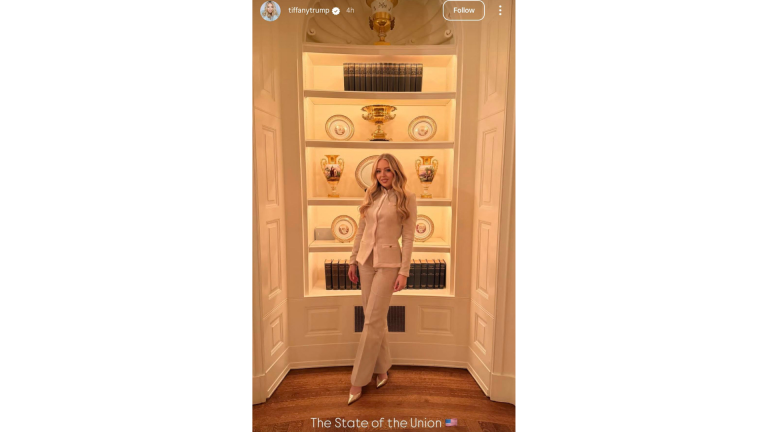
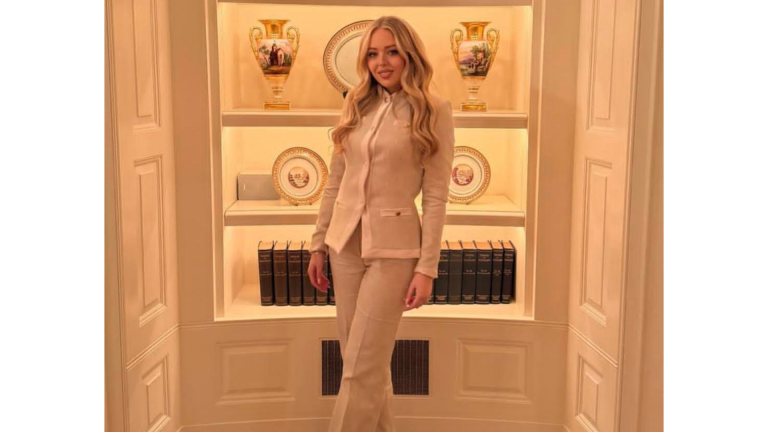
Nine months after welcoming her first child, Tiffany Trump stepped into the national spotlight at the State of the Union in a look that felt deliberate, composed, and unmistakably polished. The 32-year-old appeared in a cream two-piece suit trimmed in white with gold button detailing, paired with pointed gold heels and her signature loose blonde curls falling over her shoulders.
It was a carefully judged appearance. Tiffany, who gave birth to her son Alexander Trump Boulos in May with husband Michael Boulos, shared a behind-the-scenes glimpse of her ensemble on Instagram with the succinct caption: 'The State of the Union'. In a setting dominated by political messaging and economic debate — US President Donald Trump had previewed the address as a lengthy speech focused on what he described as record-breaking achievements — her sartorial message was quieter but no less intentional.
For new mothers navigating their wardrobes after pregnancy, her look offered something far more relevant than red-carpet theatrics. It demonstrated how structure, tone, and proportion can restore a sense of control and identity at a time when both body and routine may feel unfamiliar.
Why Postpartum Dressing Is About Identity, Not 'Bouncing Back'
Let's begin with the why.
Postpartum style is not about shrinking yourself back into old clothes or chasing a pre-baby silhouette. It is about recalibration. After pregnancy, many women experience shifts in shape — a fuller bust, softer midsection, wider hips — alongside practical considerations such as comfort, ease of movement, and confidence in public settings.
In cities like London, where presentation often carries professional weight, returning to events, offices, or formal engagements after maternity leave can feel daunting. What Tiffany's ensemble illustrates is that you do not need trend-led experimentation. You need structure, coherence, and clothes that work with you, not against you.
Here are 10 practical, editorial fashion lessons drawn from her appearance — each rooted in the realities of postpartum dressing.
1. Start With Structure: The Blazer as Anchor
A tailored blazer is arguably the most forgiving garment in a postpartum wardrobe.
Tiffany's cream jacket defined the shoulders while gently skimming the waist. This kind of tailoring frames the torso without clinging to the midsection. For women who feel in-between sizes, a blazer offers stability—visually and emotionally.
Look for:
- Slightly nipped-in waists rather than boxy cuts
- Soft internal structure rather than stiff padding
- Enough length to elongate the torso
In British terms, it's the difference between looking 'thrown together' and 'properly turned out'.
2. Choose Cream Over Stark White
White can be unforgiving under bright lights, particularly if your skin tone has shifted hormonally.
Cream, ivory, or soft ecru — as Tiffany chose — reflects light gently and reads sophisticated rather than stark. It also pairs beautifully with gold accents, which warm the complexion.
For daytime London events, cream feels more approachable than optic white, particularly in autumn and winter months when natural light is cooler.
3. Use Detailing to Create Interest Without Bulk
Gold buttons and white trim elevated Tiffany's suit without adding volume.
After pregnancy, many women prefer cleaner lines. Instead of ruffles or heavy layering, look to hardware, subtle piping, or tonal stitching for dimension. These details catch the eye and break up large blocks of fabric without complicating the silhouette.
It is the difference between decoration and refinement.
4. Invest in Mid-Weight, Forgiving Fabrics
Fabric choice matters enormously postpartum.
While the precise textile of Tiffany's suit was not specified, its structured drape suggests a fabric substantial enough to hold shape. Mid-weight crepe, wool blends, or stretch suiting materials provide structure while allowing movement.
Avoid overly thin fabrics that cling or extremely rigid materials that restrict. Comfort does not mean compromising on polish—it means choosing cloth that works with natural contours.
5. Understand Proportion: Balance Top and Bottom
A well-balanced two-piece prevents disproportion, which can feel more noticeable after pregnancy.
Tiffany's tailored trousers complemented the blazer, maintaining a clean vertical line. For many women, high-rise trousers with gentle stretch offer support and smoothness without discomfort.
If opting for skirts, midi lengths often provide both coverage and elegance—particularly for formal settings.
6. Heels Are Optional — Line Length Is Not
Tiffany completed her look with pointed gold heels, elongating her frame.
However, postpartum dressing must account for practicality. Hormonal changes can affect foot size and comfort. A pointed flat, slingback, or modest block heel can achieve a similarly lengthened line without the strain of high stilettos.
In London, where cobbled streets and endless escalators are a reality, chic practicality is not only acceptable—it is wise.
7. Keep Hair Soft to Offset Tailoring
Her loose curls, worn forward over her shoulders, softened the suit's sharpness.
This contrast is strategic. Structured clothing paired with overly rigid hair can feel severe. Soft waves, a low chignon, or even a sleek ponytail introduce ease.
For new mums juggling childcare and work commitments, low-maintenance glamour is often the sweet spot.
8. Embrace Tonal Dressing for Instant Cohesion
Tiffany's cream-on-cream palette created a seamless visual line.
Tonal dressing is particularly flattering postpartum because it avoids harsh horizontal breaks. Wearing similar shades head-to-toe elongates the body and appears effortlessly considered.
Beige, camel, navy, and soft grey all work beautifully within a British wardrobe context.
9. Dress for the Room, Not the Commentary
Public appearances after childbirth often attract commentary focused on appearance rather than achievement.
At the State of the Union — an address shaped by economic concerns, polling figures, and political messaging — Tiffany's understated ensemble allowed her to appear composed without distracting from the occasion.
For everyday women attending weddings, returning to work, or stepping into formal settings, the principle is the same: your clothes should support your presence, not become the headline.
10. Redefine Your Personal Uniform
Perhaps the most powerful takeaway from Tiffany's appearance is the importance of consistency.
Her look did not feel like a departure. It felt like an evolution of an existing aesthetic–refined, neutral, polished. That continuity matters postpartum. Rather than reinventing yourself entirely, adapt your previous style codes to your current body.
If you loved tailoring before, return to it—but reassess fit. If you gravitated towards neutrals, refine your palette. Identity in dress should feel cumulative, not corrective.
Postpartum Style in the Public Eye — and at Home
While Tiffany Trump's appearance occurred in one of the most scrutinised political stages in America, the underlying lessons translate to everyday life in Britain.
Postpartum dressing in London may involve:
- School runs in Richmond
- Client meetings in the City
- Family gatherings in Surrey
- Evening events in Mayfair
Across all of these scenarios, the fundamentals remain: structure, proportion, cohesion, and comfort.
There is also a broader cultural shift taking place. Increasingly, women are rejecting the language of 'getting your body back'. Instead, they are building wardrobes that reflect who they are now — mothers, professionals, partners, individuals—without apology.
Tiffany's cream suit, worn nine months after giving birth, did not attempt to narrate her postpartum journey. It did something subtler. It demonstrated ease within a formal, high-pressure environment.
And perhaps that is the real lesson for new mums wondering what to wear as they step back into view.
Choose clothes that restore your sense of authorship. Prioritise tailoring that respects your current proportions. Opt for tones that brighten rather than overwhelm. And remember: polish is not about perfection. It is about intention.
In the end, postpartum style is less about returning to who you were and more about presenting who you are—structured, self-assured, and entirely your own.