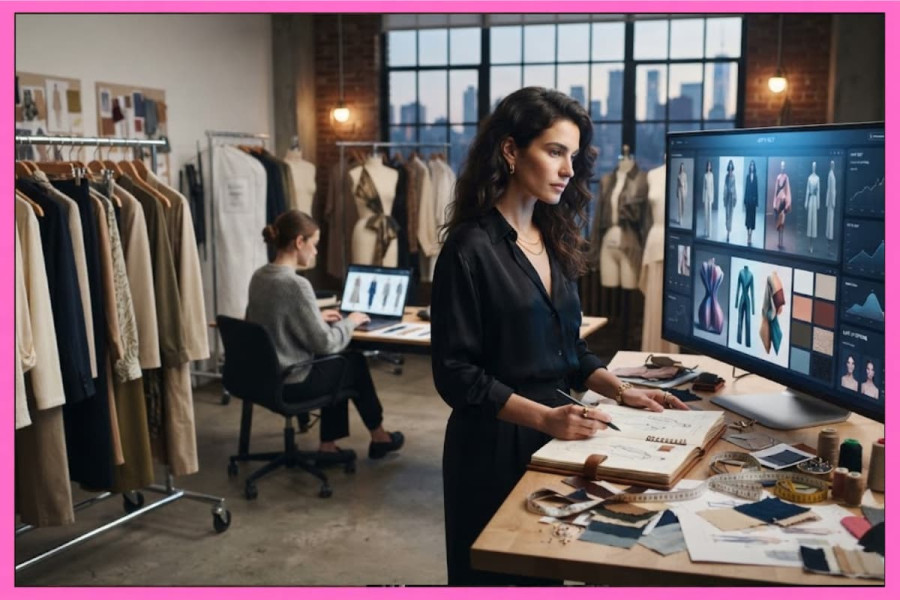
Artificial intelligence has made its way further into the fashion industry, with Google testing new AI tools alongside designers Jane Wade and Sergio Hudson ahead of New York Fashion Week's Spring/Summer 2027 season.
Rather than using AI to replace the creative work behind a collection, the collaboration focused on some of the more time-consuming and expensive parts of preparing for a runway show. Google's Envisioning Studio worked with the two designers to develop and test fashion-specific tools through its Flow AI creative studio, with one focused on styling and the other on runway visualisation.
The experiment offers a glimpse at how AI could become part of the fashion workflow, particularly for independent designers who have to balance creative decisions with tight budgets and demanding production schedules.
Jane Wade Uses AI To Visualise Looks Before Production
For New York-based designer Jane Wade, the collaboration focused on one of the most hands-on stages of preparing a collection: styling each runway look.
According to Vogue Business, Wade worked with Google to turn parts of her traditionally hand-sketched process into a digital workflow. The AI styling suite let her team visualise garments in different colours, fabrics and styling combinations before making expensive production decisions.
The advantage was particularly significant for a smaller studio. Wade explained that being able to see a look before cutting the fabric could potentially save around $1,000 (£742) at the factory.
The tool also allowed Wade and her stylist to experiment with accessories, eyewear, hair and make-up by layering different options onto images of models taken during real fittings. The system could produce several views of a look, including full-body images, headshots and detail shots.
However, the AI-generated visualisations were not treated as a replacement for physical fittings. Wade made clear that every look was still tried on a model before final decisions were made.
That distinction is important as fashion brands continue to explore generative AI while also facing questions about authenticity, creative ownership and the role of human professionals.
AI Also Helped Create Model Dressing Cards
Google's collaboration with Wade went beyond experimenting with outfits.
The designer also worked with the company on an automated model card generator designed to simplify a process that would normally involve Adobe Illustrator. The tool could create print-ready dressing cards according to the specifications required by Wade's team.
For a runway show, these cards can help organise the details of each look and communicate styling information across the production team. Wade said the new workflow helped improve visual alignment among her staff, particularly because not everyone on the team had the same level of experience with Adobe software.
Still, Wade drew a clear boundary around where she wanted AI involved. She said the most expensive elements of garment production, including pattern-making, materials and labour, remained outside the reach of the technology.
She also stressed that she wanted final campaign imagery to involve real people, photographers and stylists.
Sergio Hudson Tests AI for Runway Staging
Sergio Hudson approached the technology from a different angle.
For Hudson, the challenge was not styling individual looks but figuring out how his runway show would work inside a physical venue. He collaborated with Google on an AI-powered runway visualisation tool that could simulate elements including venue dimensions, lighting, mood and prop placement.
The system also allowed Hudson to work within budget parameters while exploring different staging options. That meant he could make changes digitally before committing money to physical construction or expensive production revisions.
For independent designers, those costs can quickly add up. A change to lighting, staging or the physical layout of a show can require additional work from production teams, making experimentation more financially risky.
Hudson said the technology allowed his team to run numerous spatial iterations without immediately spending money on physical builds.
In that sense, AI was being used less as a designer and more as a planning tool — giving the creative team an opportunity to test ideas before deciding which ones were worth taking into production.
AI Still Has Limits on the Runway
Despite the benefits, neither designer presented the technology as a perfect replacement for traditional fashion processes.
Hudson said the AI tool struggled to fully reproduce the energy, environment and silhouette of an actual runway show. Those elements depend heavily on the experience of being in the physical space and seeing models move through it.
Wade similarly acknowledged that AI can produce mistakes and inconsistencies. For her, the value of the technology was in speeding up decisions and allowing her team to explore possibilities before committing time and money to them.
That cautious approach reflects a wider tension within the fashion industry. While AI is increasingly being discussed across fashion businesses, designers remain concerned about intellectual property and what could happen to proprietary creative work entered into AI systems.
Google's Envisioning Studio said its approach is to develop technology alongside the creatives who will use it, rather than simply introducing finished products into creative industries.
What Google's Fashion AI Experiment Means
The collaboration with Jane Wade and Sergio Hudson does not signal that AI has replaced traditional fashion design at New York Fashion Week.
Instead, it shows how generative AI is beginning to find a place behind the scenes — helping designers visualise ideas, organise information, experiment with styling and plan expensive runway environments.
New York Fashion Week's Spring/Summer 2027 season officially began in September, with the CFDA's schedule featuring dozens of runway shows and presentations across the city.
For smaller labels in particular, tools that can reduce unnecessary production costs or make visual planning faster could prove useful. But the experience of Wade and Hudson also highlights the limits of what AI can currently do.
The designers are still making the creative decisions, working with real models and relying on physical fittings and production teams.
For now, then, AI's growing role in fashion appears to be less about putting a machine at the designer's desk and more about giving designers another way to test an idea before turning it into something real.