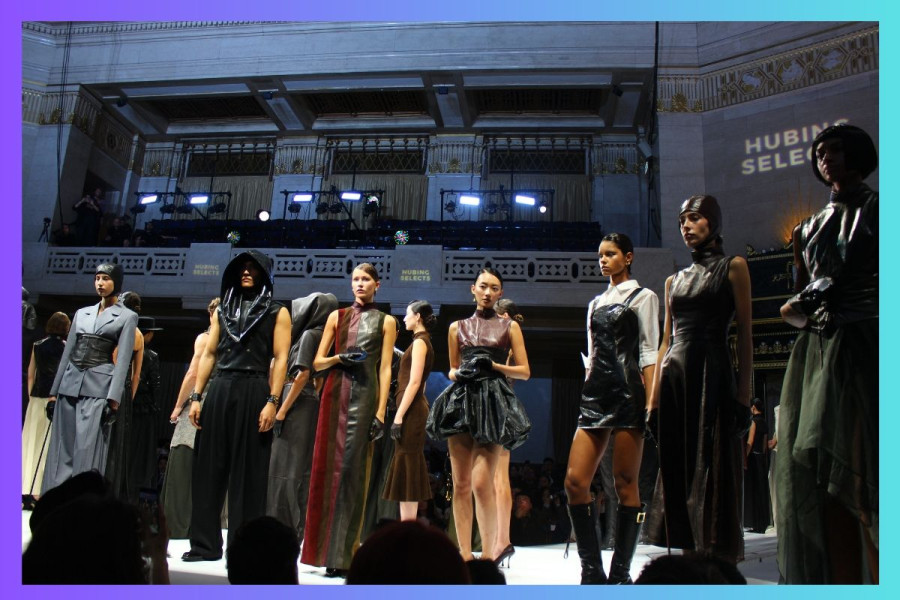
HUBING SELECTS presented its third season at London Fashion Week on 19 September with a collection built around a single material and three distant dates. Urban Grace: Leather & Light moved through 1930, 2030 and 3030, using Haining leather as the thread running between them.
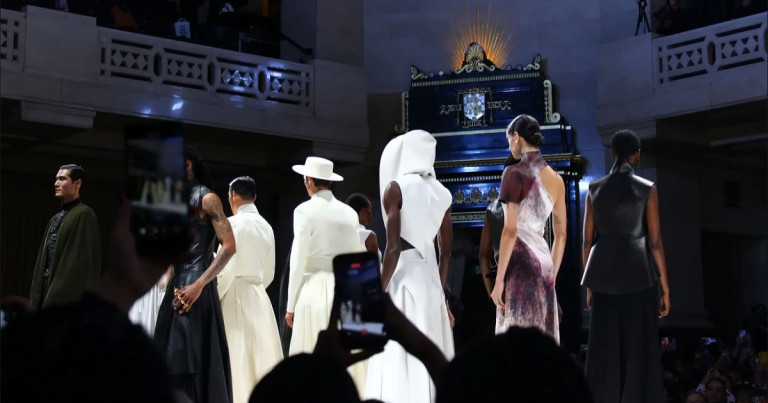
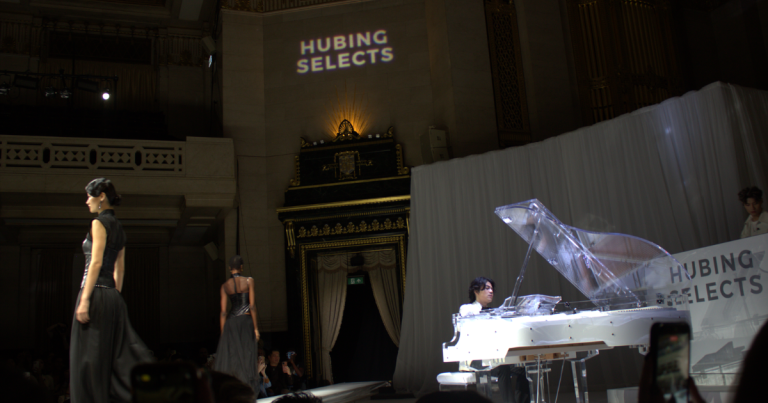
That structure gave the show its shape. Founder Hu Bing framed the collection as a conversation between Shanghai and London, between heritage and technology, and between protection and exposure. A transparent grand piano stood at the far end of the runway, where the Chinese pianist Yangyang Ruan played live to open the show.
What made the collection unusual was how little the leather behaved like leather. According to the brand, the leather was developed through the supply chain in Zhejiang province. It was worked to look lighter, softer and more fluid than the heavy or highly polished versions the material is usually associated with. One look paired an olive green leather vest with an asymmetrical tulle skirt, the structure of the vest set against a skirt that floated around it.
Ritual White Opens in the 1930s
The first chapter dressed the past in matte white leather from Haining, cut with silk and gauze into restrained, almost ceremonial silhouettes. It drew on both Eastern and Western dress of the period.
The lighting stayed cool and white, layered with wind, birdsong and ambient sound built to evoke Shanghai and London at once. The effect was closer to ritual than to a conventional runway opening.
Flexible Armour Hardens the Line
The second chapter jumped to 2030 and took its cues from Roman gladiatorial armour, with the collaborating designer Aya translating protective structures into tailoring. Black leather carried this section, worked through with wine red and cognac, and the shoulders, chest and waist were sculpted until the clothes read as architecture.
Those protective shapes surfaced across the collection. A vivid red high-neck collar cut across a structured leather vest and pleated skirt. A cut-out leather top draped over a model's torso like plating, and sheer tiered tailoring arrived beneath a precise wide-brim hat. The side lighting warmed, and a British deep-house rhythm took over from the piano.

Gown of Light Arrives in 3030, Finishing in China
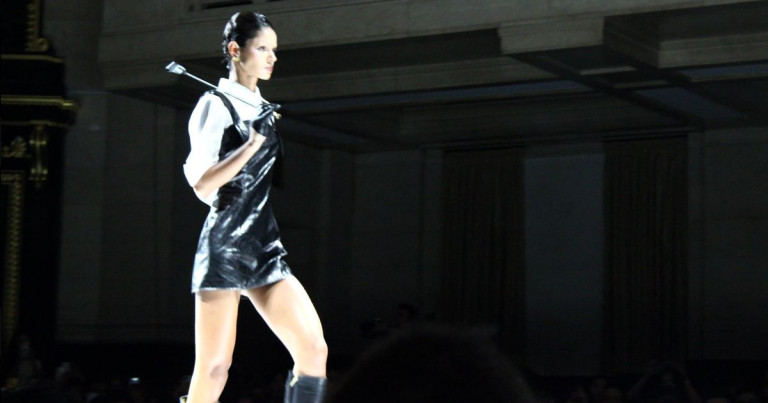
By the final chapter the leather had been pushed to a metallic second skin, with gauze around it that appeared to weigh nothing. The clothes suggested a future in which fashion might be less about dressing for a particular place than carrying something of that place with you. The music stripped back, structured beams of cool white light crossed the space, and the show closed on the resonance of a single piano note.
The season also introduced a proposition of Hu Bing's, centred on the craftsmanship and technical expertise behind the finished garment. 'Finishing in China is not a claim about where materials originate,' he said. 'It is about who finishes the work — Chinese craft and supply chains turning design into garments the world can see, wear and buy.'
In practice that meant tracing the garment from material selection and sampling through to final production, placing the finishing inside the creative process rather than after it. The staging followed the same logic. Romantic detail was set against sharp tailoring, and the Shanghai of the 1930s was brought on stage before it met the London hosting the week.
A Decade on the London Schedule
For more than a decade, Hu Bing has served as the British Fashion Council's London Fashion Week ambassador for China. The council named him its first Chinese International Ambassador for London Collections: Men in 2015. He founded HUBING SELECTS in 2024, as a platform for bringing Asian designers onto international stages.
'Ten years was a threshold; the eleventh marks a new beginning,' he said. 'In the next decade, I want to represent Chinese craft, Chinese supply chains, Chinese brands and the young designers walking this road with me.'
Qi Qi, Dongna Xie and Yun Xiang Hao carried some of the collection's defining looks, with a creative contribution from the multidisciplinary artist Darren Johnston, and Hu Bing took the stage himself at the finale. What held the three chapters together was not the century each was set in but the hide itself, asked to be ceremonial, then armoured, then almost not there at all.