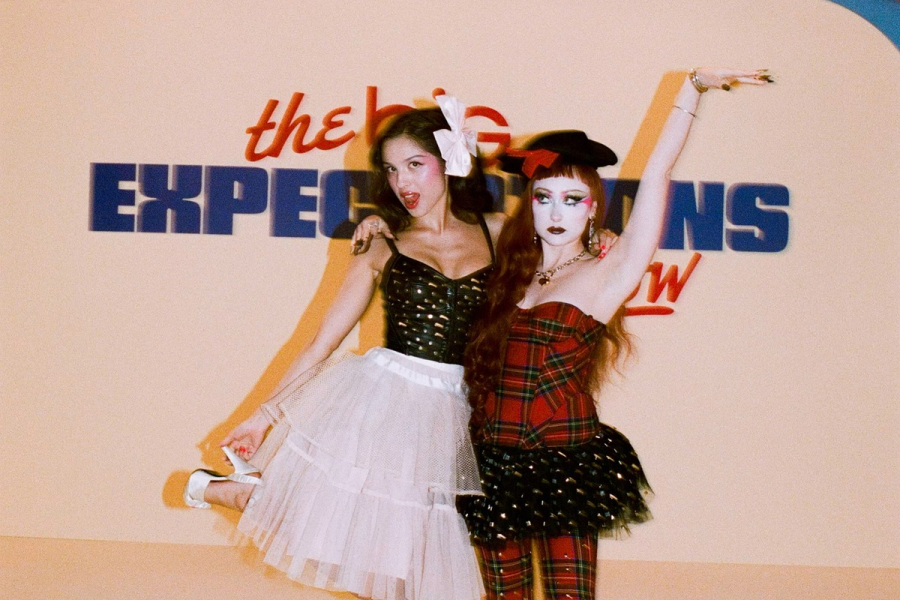
An animated version of Chappell Roan appears to lose an arm in the new 'Expectations' video, while Olivia Rodrigo seems to grow a third hand. Viewers took screenshots of the moment and claimed generative AI was behind the sequence, shortly after Rodrigo told The Hollywood Reporter, 'I would never use AI in any of my music.'
Her words left little room for doubt. She called AI a hard line, and the closest she had come was a joke with producer Dan Nigro, asking ChatGPT for title ideas and finding every suggestion awful. Her stance focused on songwriting rather than visuals, but that nuance faded as freeze-frames of the video circulated across social media.
Inside the Retro Game Show Look
The video, directed by Bardia Zeinali, is a deliberate throwback to 1980s and 90s television. It casts the two singers as contestants in parodies of Jeopardy!, Hollywood Squares, Wheel of Fortune, and Family Feud, with David Byrne as the fictional emcee, Johnny Johnson. The dated, slightly rough finish is the concept, which is why the cartoon sections look nothing like polished modern CGI.
Rodrigo's Handmade Track Record
Her recent visuals lean on physical, hand-crafted work. The credits for the original 'Expectations' lyric video list a team of paper cutters and a colourist, with the animation shot at a stop-motion department. A fan collage shared during the row pairs stills from that video, where layered paper figures sit beside the line about big expectations, with storyboards and pencil sketches of retro cartoon women. Even so, the trail of drawings, cutouts and storyboards sits in sharp contrast to the idea of handing creative work to an algorithm.
love when my fave refuses to use ai so she instead hires talented people for the sake of making good art... olivia you will forever be iconic pic.twitter.com/BKUnuMCrBH
— miguel (@cowboyinwoods13) October 17, 2026


Smear Frames vs Layering Errors Explained
Two separate things are being blended together in the debate. A smear frame is intentional. An animator stretches or blurs a moving limb across a few frames so the eye reads speed, and the technique runs from early cartoon pioneers to Tex Avery and Chuck Jones. It looks smooth in motion and strange when paused.
The missing arm and shifting details are a different case. Creative Bloq reported that in one shot Roan appears to lose a hand while Rodrigo appears to inherit it. Other posts mocked inexperienced viewers for mistaking minor accessory changes, such as a necklace shifting from six to seven stones alongside perceived makeup shifts, as proof of synthetic generation.
This is a smear. It’s an inconsistency done in animation when there’s a lot of movement . Chappell’s hand is moving fast so in order to save time, they cut out a few frames which is why she only has four fingers in the movement. This explains it frame 1https://t.co/fbQZbJkFPP https://t.co/bDUTGaCmJd
— Tech Jacket (@MadamstyxXo) October 16, 2026
Replies explained that such variation is standard in hand-drawn animation, where chest movement, perspective shifts, and paused frames naturally create subtle inconsistencies. These moments reflect colour-fill or layer placement slips common in 2D work rather than generative AI.
Proof of Work in the Age of AI Slop
A behind-the-scenes clip quickly became the main counter-evidence online, offering a rare peek at how the sequence was actually put together. It shows hand-drawn characters, a mix of 2D and 3D animation and old analogue TV monitors in action. Yet no official statement has come from Bardia Zeinali or the animation team behind the sequence, so the defence still rests on fans doing their own detective work.
bts of the hand-drawn characters, 2D & 3D animation, and analog TV screens used to create the retro graphics of the expectations music video 📺
— olivia’s livies 🩷 (@LiviesHQ) October 17, 2026
watch the music video now!! https://t.co/kM9XlNJhvY pic.twitter.com/hiuyZ96MBA
It leaves artists playing a strange game of show-and-tell. The second a freeze-frame goes viral, creators are suddenly expected to parade behind-the-scenes drafts and raw files just to prove human hands actually touched the screen. Meanwhile, classic animation tricks older than the internet keep getting misdiagnosed as tech errors—and as long as the production team stays quiet, online sleuths will keep hitting pause.