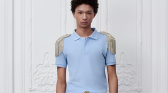
Knowing your Hermès from your Loewe may be one thing, but saying the names out loud is a very different challenge. Duolingo has turned fashion's notoriously tricky designer names into an unlikely language lesson with 'The Phonetic Collection', a seven-piece capsule created for New York Fashion Week with designer Megan O'Cain.
Instead of simply publishing another pronunciation guide, the language-learning company has put phonetic spellings directly onto clothes and accessories. The collection translates names including Hermès, Givenchy, Jacquemus, Moschino, Loewe, Comme des Garçons and Issey Miyake into English-friendly pronunciation cues.
The result is part fashion experiment, part advertising stunt and part reminder that being able to recognise one of the world's biggest luxury labels does not necessarily mean knowing how to pronounce it.
Fashion Names Become Lessons
Duolingo describes the project as 'SS27: The Phonetic Collection', with seven capsule pieces designed to turn pronunciation into part of the garment itself. O'Cain, who competed on the second season of Netflix's Next in Fashion, worked with Duolingo's creative team on the designs.
Duolingo created a "Phonetic" collection to help you pronounce fashion brand names pic.twitter.com/ap4d5J5ofK
— Modern Notoriety (@ModernNotoriety) September 9, 2026
Among the clearest examples is a lime-green handbag emblazoned with 'air-mess', Duolingo's English-language pronunciation cue for Hermès. A jacket, meanwhile, displays 'zhee-vahn-shee' for Givenchy. The designs use familiar fashion shapes while replacing the expected luxury branding with oversized phonetic lettering.
Duolingo's own pronunciation guide accompanying the project gives Hermès as 'air-MESS', Givenchy as 'zhee-vahn-SHEE', Jacquemus as 'zhahk-MOOS', Moschino as 'moh-SKEE-noh' and Loewe as 'loh-EH-vey'. It renders Comme des Garçons as 'kohm deh gar-SOHN' and Issey Miyake as 'ee-SAY mee-YAH-ke'.
The spellings are deliberately aimed at English speakers rather than being formal International Phonetic Alphabet transcriptions. Duolingo chief marketing officer Manu Orssaud has explained that phonetic spellings can differ according to a speaker's language and familiar sounds, so the company chose versions intended to be intuitive for an English-speaking audience.
Americans Struggle With Hermès
The joke has some research behind it. Duolingo commissioned YouGov to question more than 2,600 Americans about designer-name pronunciation. One of the most striking findings concerned Hermès: 62 per cent said they were confident they could pronounce the French luxury house correctly, while only 15 per cent selected the correct pronunciation. Nearly 46 per cent also believed the 'H' should be pronounced.
Other labels produced considerable uncertainty. According to the research released with the campaign, 62 per cent of respondents said they were not confident pronouncing Jacquemus, followed by 60 per cent for Issey Miyake, 58 per cent for Comme des Garçons and 55 per cent for Loewe.
Those figures are important when describing the collection. They show widespread uncertainty around the names, but they do not mean Duolingo scientifically determined an absolute list of the seven most mispronounced fashion brands in the world. The research was conducted among Americans and focused on the designer names selected for the study.
Duolingo Heads to NYFW
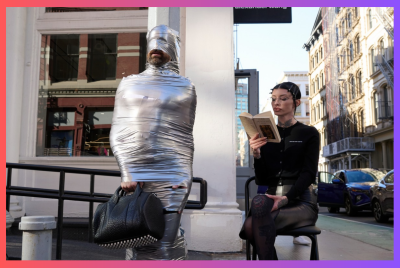
The collection has also moved beyond social media. Duolingo staged a two-day public pop-up at Null Object in Manhattan on 9 and 10 September, timed around New York Fashion Week. Visitors could see the pieces, test their knowledge of fashion pronunciation and potentially take home selected designs.
There was one particularly Duolingo twist: instead of bidding with money for selected pieces, visitors could use their Duolingo streaks. The mechanic connects the fashion activation directly to one of the app's best-known features, which counts consecutive days of learning activity.
The campaign is also appearing through social content and outdoor advertising in New York, making the project less of a conventional clothing launch than a language-learning stunt built around Fashion Week.
And despite the luxury names being referenced, the garments are not collaborations with Hermès, Loewe, Givenchy or the other fashion houses. They are Duolingo and O'Cain creations that use phonetic interpretations of those names as the central joke.