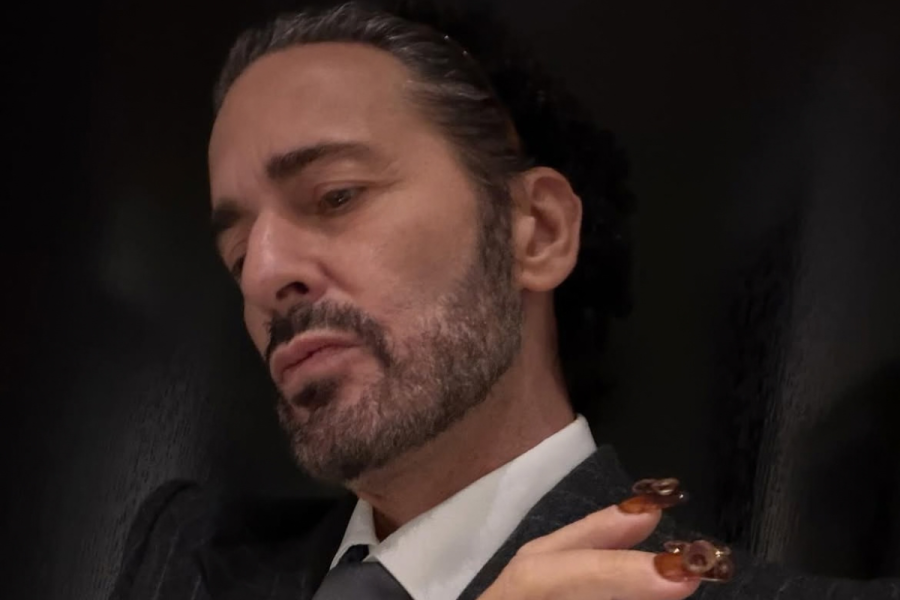
Marc Jacobs has taken aim at fashion's growing reliance on creative directors to solve its problems, arguing that 'a bunch of non-creative people' believe the industry's struggles can be fixed simply by changing the person designing the clothes.
The veteran designer made the pointed comments while discussing the ongoing fashion slump and the wave of new creative appointments across major labels on The Business of Fashion Podcast. Asked about the industry's belief that new designers could provide a solution, Jacobs said: 'What I see is a bunch of non-creative people thinking that this all hangs on a creative person. And I think it's just a big mistake.'
His remarks come as fashion houses continue to reshuffle their creative leadership, putting designers under pressure to revive brands while navigating commercial expectations that extend far beyond the runway.
Marc Jacobs Says Designers Cannot Fix Fashion Alone
For Jacobs, the problem is that creativity is being treated as though it operates independently from the rest of a fashion business.
The designer argued that creative directors need more than talent and a strong collection to make a label successful. Designers require sufficient time and resources, while their ideas must also be supported by teams capable of turning creative concepts into commercial products.
Factories, retail networks and the wider business operation all play a role, meaning Jacobs does not believe a designer can reasonably be expected to carry an entire fashion house on their shoulders.
Jacobs also questioned the constant cycle of replacing designers in the hope that a new creative vision will automatically reverse a brand's fortunes.
'You can put a different logo over a designer's head or you can change the store that clothes are available in, but there's an exhaustion, I think, from all of this stuff,' he said.
He added: 'And I don't know that the world even knows who's where at any given point.'
The comments amount to a criticism of an industry increasingly focused on high-profile creative appointments, suggesting that changing a creative director does not necessarily address the deeper commercial and structural issues facing a fashion house.


His LVMH Experience Adds Context to His Argument
Jacobs' argument is particularly striking because his own label has recently entered a major new chapter.
In September, WHP Global and G-III Apparel Group completed the acquisition of the Marc Jacobs brand from LVMH, with the two companies forming a 50/50 joint venture to own its intellectual property while G-III acquired the operating business.
The transaction ended Marc Jacobs' long association with LVMH, which had backed the label since acquiring a majority stake in 1997.
Reflecting on his time under LVMH, Jacobs said the backing available to his label had effectively reached a ceiling.
'We might have a tote bag that's successful and we might have our show that's been applauded ... [but] LVMH was not going to open stores or pour money into this place,' he said.
Jacobs sees an opportunity for the brand to change and grow under its new ownership, although without guarantees.
'There's an opportunity for something to change and grow, which certainly wasn't the case if we remained at LVMH,' Jacobs said, describing the previous situation as 'a maintenance program.'
His own experience adds context to the central point behind his criticism: a designer can create the vision, but the business surrounding that vision must provide the investment, infrastructure and support needed to make it work.
Rather than simply changing the creative when a fashion house struggles, Jacobs appears to be calling for a broader examination of everything behind the clothes.
And amid an industry increasingly focused on who will take the next creative director job, his message is blunt: changing the designer is not necessarily the same thing as fixing the business.