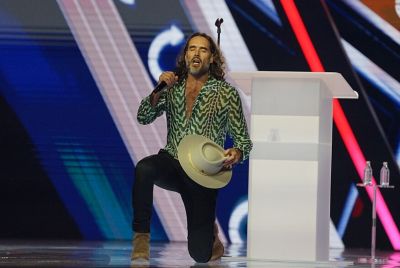
A man turns a small card towards the woman he is about to marry, and the word printed on it is 'Obey'. Sixteen years later, after learning how his story ended in court, viewers are returning to the clip of Russell Brand and Katy Perry at the 2010 Vanity Fair Oscars party.
Brand, 51, is due to be sentenced today at Southwark Crown Court after a jury convicted him on Thursday, 5 November, of one count of rape and three counts of sexual assault involving four women. He denies ever having sex without consent. The clip has resurfaced between verdict and sentence, prompting strangers to ask what might have been visible all along.
The Resurfaced Oscars Clip
In the GMTV interview, Perry tells the reporter that Brand did not watch the ceremony. He answers by holding up a tag from Shepard Fairey's Obey clothing line before launching into a monologue. As the interviewer asks how she copes with him, he leads her away by the hand while Perry tells the camera he is hilarious.
Many people have rewatched old videos after learning something that changes their context. A laugh sounds different, and a brief pause feels heavier. That pattern is playing out across X and TikTok, where users who were never in the room cut, caption, and share the footage.
🤮Russell Brand with ex-wife Katy Perry at Vanity Fair award using his 'obey' signal to control her when she calls out his bullshit. pic.twitter.com/180kaDjb0x
— Truthseeker (@Xx17965797N) October 1, 2022
In 2010, the clip was initially treated as lighthearted banter between a newly engaged couple. In 2026, social media users interpret it differently. In online comment sections, some viewers frame the prop as a public sign of control, while others say Perry looked uneasy and kept checking his reaction during the exchange.


Brand and Perry's Marriage in Hindsight
Psychologists call it hindsight bias: the tendency to treat an outcome as inevitable once it is known. When a conviction lands, a raised eyebrow suddenly looks like foreshadowing and an old joke reads like evidence.
The courts draw a firm line. A party clip carries no legal weight, and the convictions rest entirely on testimony covering offences committed between 2004 and 2009 at a radio station, a recording studio, and Brand's home, where prosecutors argued he used his celebrity status to manipulate situations and commit sexual crimes.
Even so, people scrolling online aren't looking for legal proof in a ten-second red-carpet video. They are wrestling with a deeper discomfort, wondering why behaviour that feels glaringly obvious today went completely unchecked back then.
Has anyone asked Katy Perry if she accepts the idea that she was once married to a serial rapist? Interestingly, this photo of the couple was taken in October 2009 -- only a few months after the rape for which Russell Brand was just convicted allegedly took place? pic.twitter.com/XQ6K5ZyVIy
— Michael Tracey (@mtracey) November 7, 2026
The Reality of Narrative Control
Perry has yet to make an official statement following the verdict, though reports suggest she is considering a memoir or docuseries about their 14-month marriage. On her behalf, millions of strangers have spent days sifting through clips of her twenty-something self, turning a forgotten party moment into a subject of global debate.
Katy Perry is reportedly considering an autobiography and docuseries to share details of her marriage to Russell Brand, which sources close to the singer describe as a “very dark period” in her life.
— Katy Perry Today (@todaykatyp) November 8, 2026
According to the Daily Mail, her team has been in discussions with streaming… pic.twitter.com/HS4oANnGtY
The guilty verdict brings legal resolution for the victims of Brand's crimes. But for the woman who once stood beside him on that 2010 red carpet, the trial outcome brings a different reality. Long after the sentence is passed and the courtroom empties, the digital record remains, leaving her past relationship to be endlessly re-examined by a feed that never forgets.