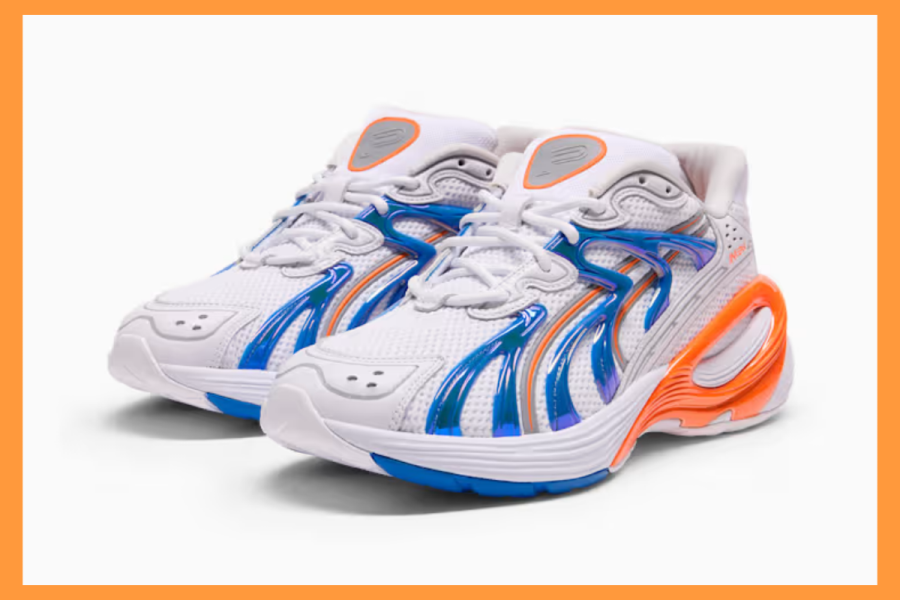
What happens when a sports legacy hands its design archive over to an algorithm? Puma tested those boundaries with the release of the Inverse, a progressive silhouette developed by running its archival Inhale sneaker through artificial intelligence tools.
Promoted as a fusion of machine innovation and human refinement, the launch has instead intensified a wider debate across footwear culture. Critics question whether handing creative iteration to data centres—and the energy and water resources required to run them—is genuine design progress or simply an unnecessary marketing hook.
Puma's Inverse Trainer Explained
The Inverse is based on the Inhale, a running shoe Puma launched in 2000 with exaggerated contours and a thick sole. It was the brand's flagship runner at the time, with e+Cell cushioning in the heel and forefoot. SFMOMA acquired a pair in 2001, and Puma has since reissued the shoe, including a 2024 collaboration with A$AP Rocky.
Puma describes the Inverse in three steps: the Inhale as archival observation, AI as artificial interpretation, and human refinement by its designers. The shoe launched in late 2024 in red mesh with dark amethyst and black accents, along with a midsole cage and asymmetric, mixed-material shapes.


Public Pushback on Puma's AI Design
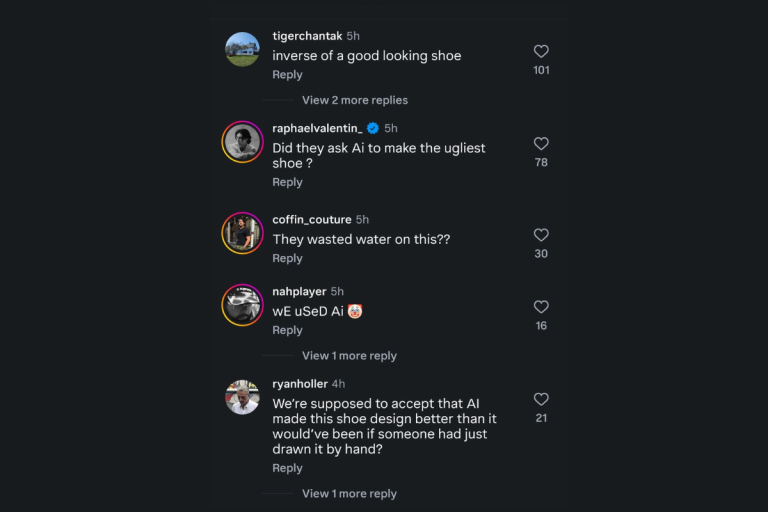
Public criticism of the Inverse centres on two distinct themes. The first is craft. Critics described the trainer as the 'inverse of a good-looking shoe', questioned whether the algorithm was asked to design the 'ugliest shoe' possible, and challenged whether machine tools could ever match a hand-drawn concept.
The second is the technology's resource cost. Generative AI relies on data centres that require substantial water for cooling. While exact consumption varies by model and infrastructure, training and running large AI systems consume millions of gallons of fresh water, making the technology's environmental footprint a growing point of friction across creative industries and directly fueling the environmental criticism directed at Puma's Inverse rollout.
How Do Rivals Use AI?
Puma is not the only sportswear brand using artificial intelligence. In 2024, Nike launched its A.I.R. project, using generative AI and 3D printing to create custom prototype shoes for 13 elite athletes, including Sha'Carri Richardson and Kylian Mbappé. Nike made it clear that AI was just a tool to boost human creativity, not replace it.
Adidas took a similar route with a tool called AI Archive. The footwear giant used the technology behind the scenes to help designers search through past shoe patterns and build new ideas faster.
The key difference is how the brands marketed it. Nike and Adidas kept AI in the background as a tool for their design teams. Puma, on the other hand, put AI front and centre, marketing the Inverse as a shoe made by artificial intelligence.
The Future of AI in Sneaker Design
How people feel about AI sneakers depends on how a brand presents them. By putting the algorithm front and centre instead of focusing on human craftsmanship, Puma led critics to focus on the technology rather than the shoe itself.
The response points to two clear issues with AI-designed footwear: doubts about whether code can match human creativity, and growing concern over the water and energy data centres use. Until brands answer both, AI-led footwear will remain a tough sell.